The Book of the Huia
Introduction
The Book of the Huia by W. J. Phillipps (1963) is a comprehensive chronicle of New Zealand’s legendary huia (Heteralocha acutirostris). This overview is provided because the book is, sadly, out of print but a kind friend of mine sent me a copy.
The extinct Huia, renowned for its striking plumage, curious bill shape, and sacred status in Māori culture, is examined from every angle in Phillipps’s volume. The author weaves together historical records, scientific observations, and Māori oral traditions to present a detailed portrait of the huia’s life and the tragic factors that led to its disappearance. The following overview organizes the book’s most compelling insights by theme, highlighting notable anecdotes, quotes, and conclusions unique to Phillipps’s work.
Historical Accounts and Early Records
Phillipps begins by tracing the huia’s recorded history, drawing on both early European accounts and Māori recollections. These historical anecdotes vividly illustrate how the huia lived and was regarded in the 19th century:
- Discovery and Misidentification: European scientists were astonished by the extreme difference between male and female huia bills. Early British ornithologists even described them as separate species before realizing they were the same bird. This taxonomic confusion underscored the huia’s uniqueness and piqued international interest in the “New Zealand wonder-bird.”
- Encounters in the Wild: Explorers and naturalists often relied on Māori guides to find huia. One 1840s account by Charles Heaphy describes how guides imitated the huia’s call; within moments, a pair of curious birds bounded through the foliage toward the sound. Observers marveled at the huia’s elegant hopping flight from branch to branch. Yet at the same time, as Heaphy admits, “we now fired…and brought each a bird down.” Such anecdotes, included by Phillipps, illustrate the mix of awe and exploitation that marked early encounters.
- Buller’s Observations: Sir Walter Buller, New Zealand’s foremost 19th-century ornithologist, studied live huias in captivity and in the wild. Phillipps recounts how Buller admired the bird’s “noble bearing” and documented its behaviors. Yet Buller also shot numerous specimens for science. In one episode, Buller watched a huia couple tenderly preen each other moments before a shotgun blast felled them both. These stark narratives reveal the era’s prevailing mindset: even as Europeans recognized the huia’s rarity and beauty, they continued to hunt it relentlessly.
- Mass Collection for Museums: The book details how demand for huia skins and mounted specimens exploded in the late 1800s. Foreign collectors and museums sent agents to obtain as many huias as possible. The Austrian taxidermist Andreas Reischek alone took over 200 huia (mostly in male-female pairs) during the 1870s–80s for European collections. In another recorded hunt, a Māori hunting party in 1863 obtained an astonishing 646 huia skins in one month for trade. Such figures convey the unsustainable scale of exploitation. Many of the preserved specimens shipped overseas were poorly mounted and have deteriorated, a fate Phillipps notes with regret. (An appendix in his book even lists the few dozen huia specimens that remained in museums worldwide by the 1960s, emphasizing how little was left of the species.)
By the 1890s, both Māori and Pākehā observers realized the huia was in serious decline. Phillipps highlights the collaborative efforts, especially by Māori leaders, to protect the bird before it was too late. Chiefs of Ngāti Huia and other iwi (tribes) placed a rāhui (sacred ban) on hunting the bird in their forests, and they petitioned the colonial government for help. In 1891, at a landmark hui (gathering) in Ōtaki, Ngāti Huia elders symbolically inducted the Governor’s infant son into their tribe, bestowing on him the name “Huia” to enlist patronage for the bird’s survival. Moved by this gesture, Governor Lord Onslow reportedly vowed in a waiata (song), “E hoa mā, puritia mai taku huia” (“Friends, take care of my huia, my treasure”). The very next year, in 1892, the government finally gazetted the huia as a protected species and even proposed creating island sanctuaries for it. Phillipps recounts these events to show that concern for the huia’s fate was mounting. Unfortunately, enforcement of protection was lax, and sanctuary plans never materialized. The stage was set for the huia’s final decline as the new century dawned.
Ecological and Anatomical Insights
A core portion of The Book of the Huia is devoted to the bird’s natural history. Phillipps draws on scientific observations and museum research to explain what made the huia so ecologically distinctive:
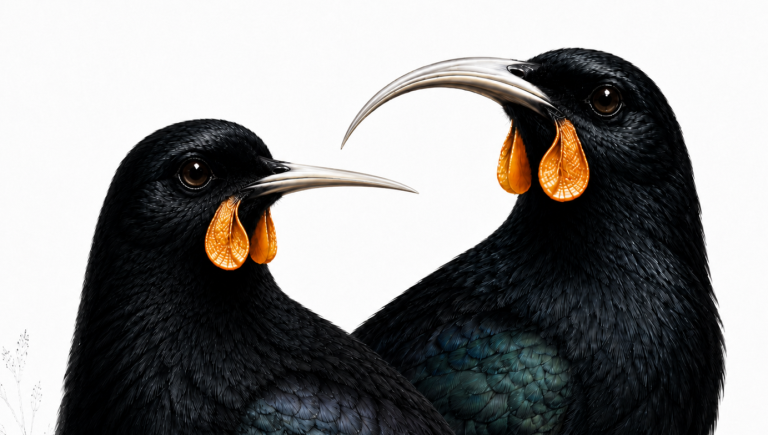
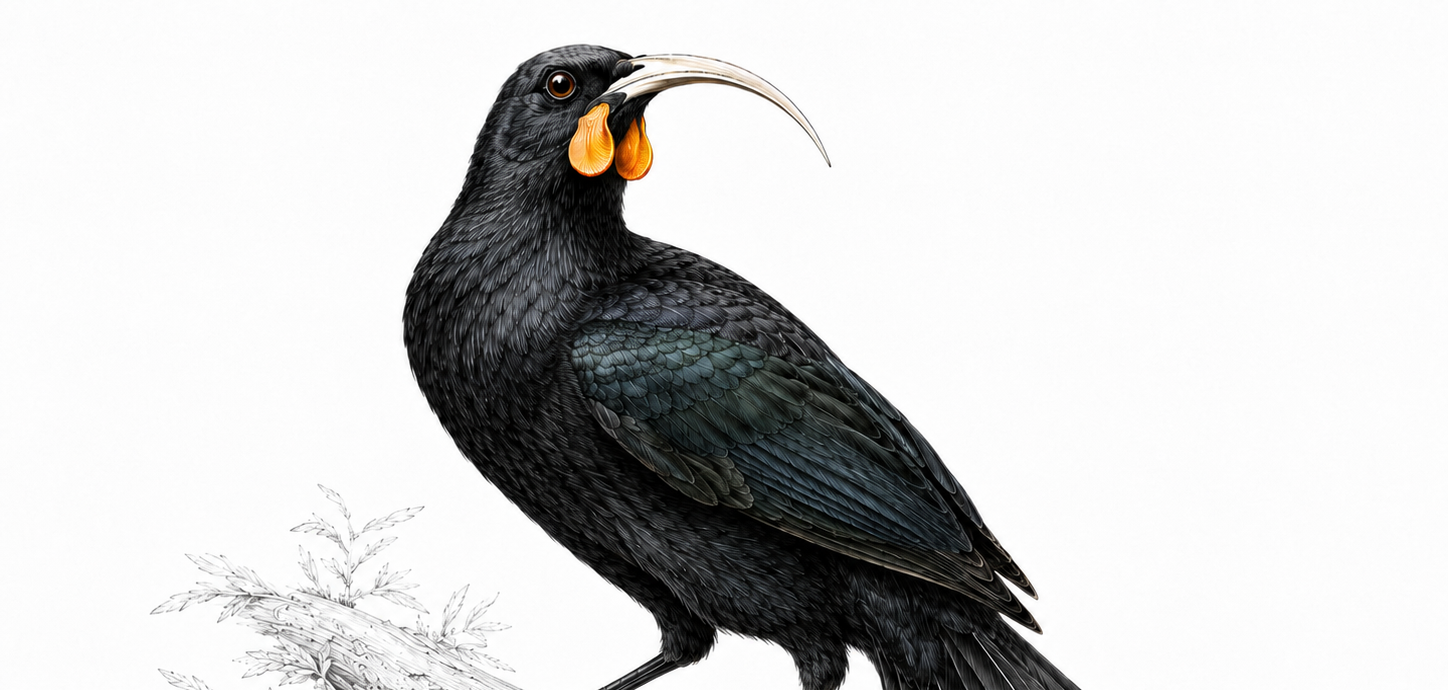
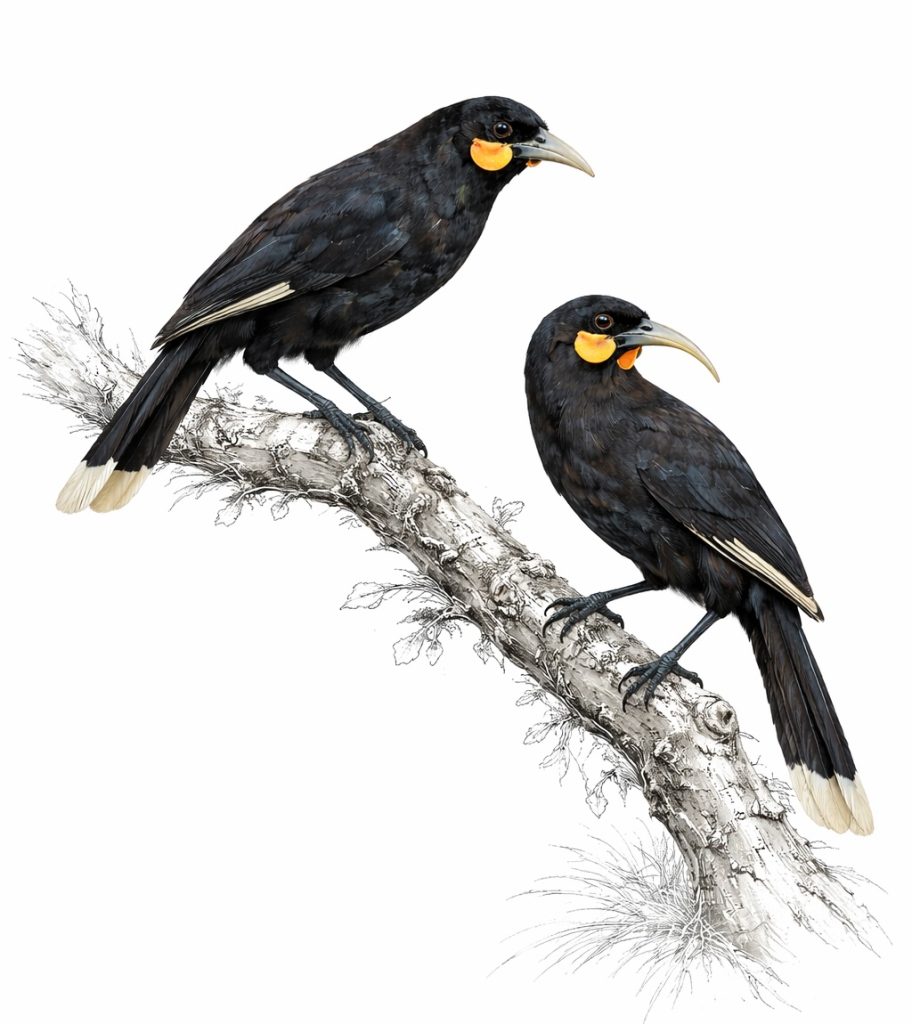
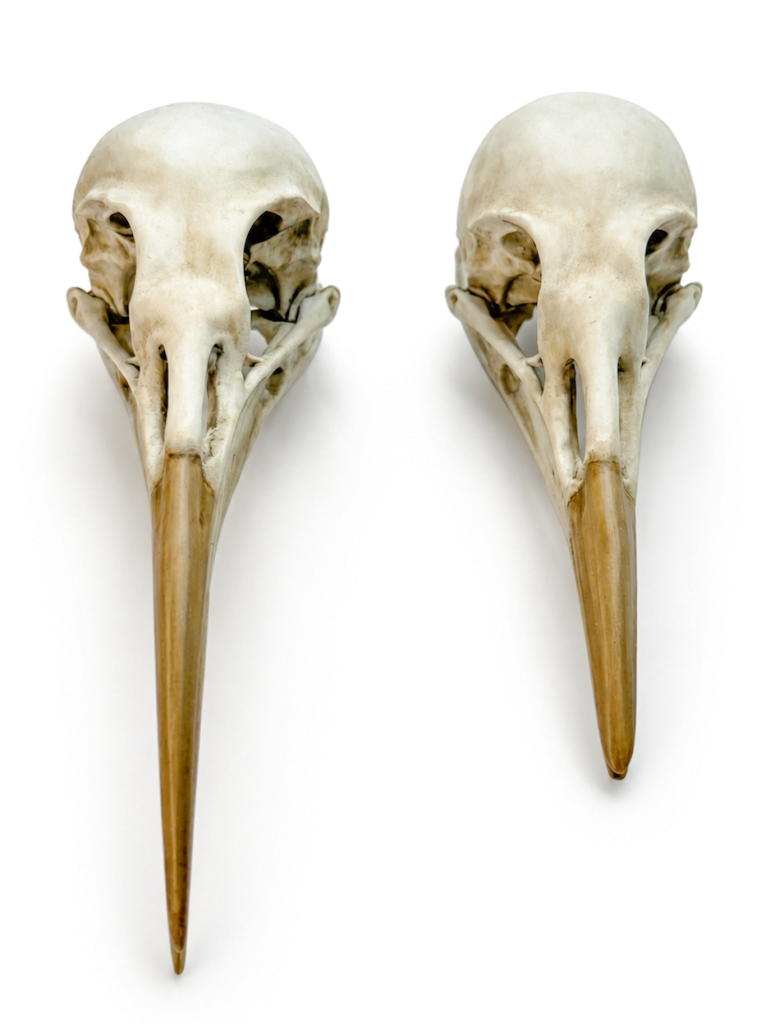
- Dramatic Bill Dimorphism: The huia was the only known bird in the world where the sexes had completely different bill shapes. The female’s bill was long, slender, and gracefully curved (about 10 cm long), while the male’s was shorter, stout, and almost straight (around 6 cm). This extreme sexual dimorphism initially misled scientists, but Phillipps explains that it actually allowed the male and female to fill complementary feeding roles.
- Cooperative Feeding Behavior: The book describes how huia pairs foraged together in a remarkable partnership. The male used his chisel-like bill to hammer and pry apart rotten logs or tree trunks, acting like a woodpecker to expose insect larvae deep in the wood. The female then inserted her long, decurved bill into crevices that the male’s hacking opened up, probing for grubs that were out of his reach. Observers even noted males courteously passing juicy insects to their mates. Phillipps includes charming field anecdotes (from old bushmen’s journals) of male huias “very politely” offering a captured spider or weta to the female. This cooperative strategy allowed a pair to exploit a range of food sources together, an adaptation virtually unique among birds.
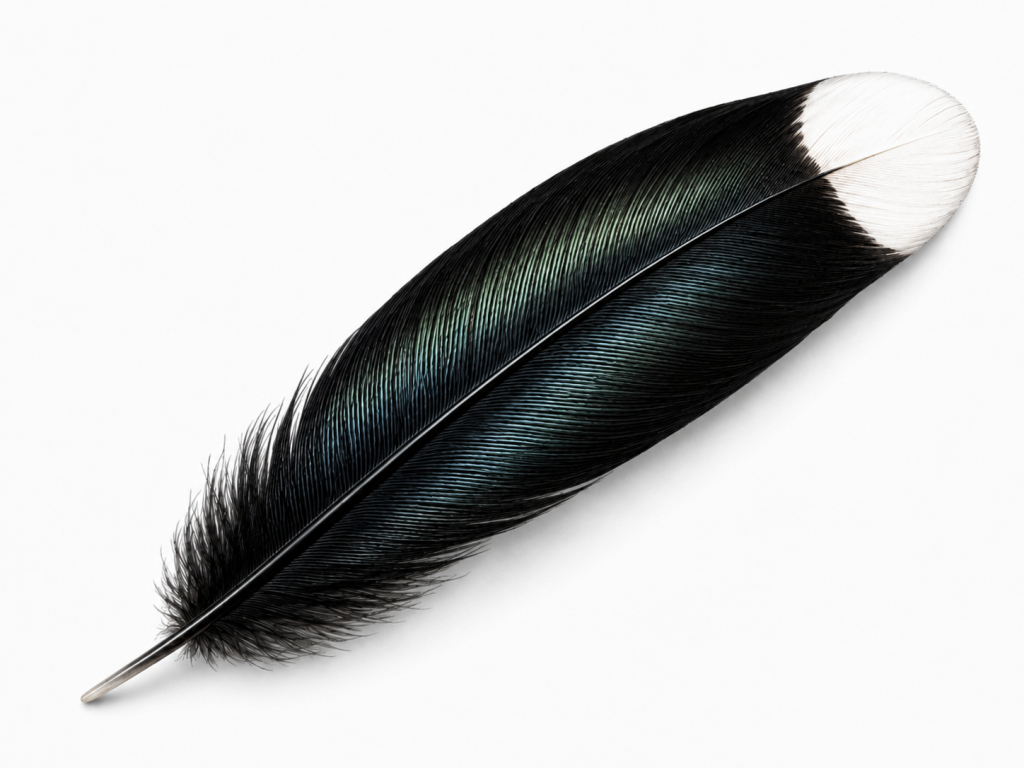
- Physical Appearance: Beyond its bills, the huia was a striking bird overall. Phillipps details its glossy black plumage with an iridescent greenish-blue sheen in good light. The long tail feathers ended in bold white tips; twelve snow-white spots that formed a band, which became the most prized part of the bird for humans. Each huia also bore bright orange wattles at the corners of its mouth (hanging like small oval lobes at the base of the bill). These fleshy wattles, which were largest in adult males, signaled maturity and perhaps breeding status. (Phillipps notes that the huia’s two close relatives, the kōkako and tīeke/saddleback, also have colored wattles, though smaller.)
- Flight and Habitat: Like many large New Zealand forest birds, huia were weak fliers. Phillipps relays eyewitness descriptions of huia moving through the forest in bounds and short glides, rarely flying above the canopy. They typically stayed under the cover of trees, hopping from limb to limb with agility but seldom covering long distances in the air. This behavior made them easy prey in cleared land. Huia were endemic to the North Island and specialized for life in ancient, undisturbed forests. According to Phillipps, they struggled to adapt to secondary regrowth or open habitats. Their range had already contracted to mountain forest strongholds (such as the Tararua and Ruahine Ranges) by the late 19th century, perhaps because they could not thrive outside dense old-growth bush.
- Voice and Call: Although no audio recordings exist, the book compiles written descriptions of the huia’s calls. Māori onomatopoeically named the bird “huia” after one of its cries: a resonant, flute-like whistle transcribed as “uiauia” (often interpreted as meaning “Where are you?”). This call was said to carry far in the forest. Huia also had softer conversational notes; Buller mentioned low whistles and trills between mates at close range. Phillipps even interviewed elders who remembered the sounds. In one case, an elder’s imitation of the huia’s call was recorded in the 1940s as a cultural preservation effort. Such accounts in the book convey a haunting sense of the bird’s lost voice.
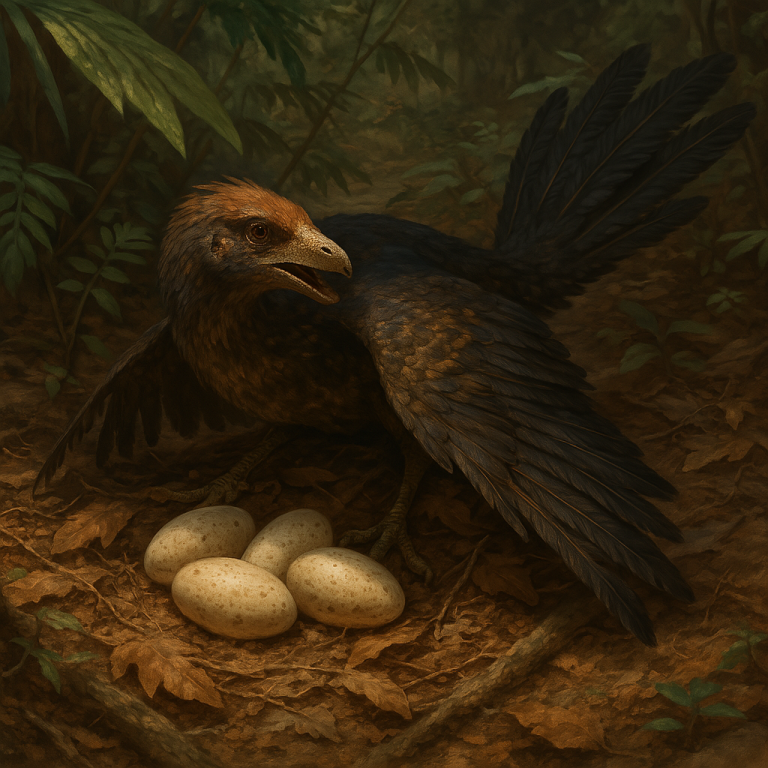
- Reproduction: The huia bred in the austral spring-summer, and Phillipps includes what little was known about its nesting. Pairs built large cup-shaped nests of sticks and fibers high in hollow trees. Clutches of two to four eggs were laid, and (as with its living wattlebird relatives) the female did most of the incubation while the male brought food. Phillipps notes that males were observed feeding females and chicks, indicating strong pair bonds and family cooperation. He also mentions an intriguing, unconfirmed report of a huia nest found in a rotten tree stump containing four eggs; evidence that, if true, would suggest the species sometimes had larger broods than expected.
All these ecological insights underscore how specialized the huia was. Phillipps concludes that the bird’s fate became tied to the fate of its native forest habitat and the absence of predators; factors that would soon drastically change.
Cultural Significance in Māori Tradition
One of the most fascinating aspects of Phillipps’s book is its exploration of the huia’s role in Māori culture and tradition. The huia was not merely a bird to Māori. It was a taonga (treasured thing), imbued with spiritual significance and woven into many customs and legends:
- A Sacred Bird (Tapu): In Māori belief, the huia was regarded as tapu, sacred or untouchable, especially because of its association with high-ranking chiefs. Phillipps explains the concept in memorable terms: “Tapu is catching; so the tapu of the individual became the tapu of the feathers and ultimately the bird.” In practice, only people of great mana (status) were allowed to wear huia feathers. If a chief wore a huia feather, that plume and the bird it came from were sanctified by his tapu. This contagion of sacredness elevated the huia to the most esteemed of birds.
- Feathers as High-Status Adornments: Huia tail feathers (black with white tips) were among the most coveted adornments in pre-European times. Phillipps notes that chiefs would wear a single huia feather in their hair as a symbol of rank and chiefly lineage. These feathers were so valuable that they became items of exchange: tribes living in the huia’s forest ranges would trade tail feathers with other iwi for prized goods like pounamu (greenstone) and shark teeth. An extraordinary archaeological find mentioned in the book underscores this network: in 1892, a cache of 70 huia tail feathers was unearthed in Otago (far outside the bird’s natural range), stored in a finely carved wooden waka huia (feather treasure box). This discovery in the south of New Zealand showed how far huia plumes traveled through intertribal trade, centuries before Europeans arrived.
- Ornamentation and Uses: Beyond single feathers, Māori fashioned elaborate ceremonial regalia from huia parts. Phillipps describes the marereko, a magnificent war head-plume composed of a full set of twelve huia tail feathers splayed in a circle. Such an ornament was worn only by the most elite chiefs on special occasions. Women of very high status might wear a pōtae huia, a headdress adorned with multiple huia heads. In this striking (and now scarcely believable) accessory, preserved huia heads with their beaks still attached would dangle around the wearer’s head and rattle together as she moved. Earrings were another form: some Māori would dry and string entire small bird skins, and huia skins (with their downy white-tipped tails) were particularly prized to wear from the ears. Even in death, the huia’s presence was important. Phillipps notes that huia feathers were often placed in the hair of deceased chiefs as part of funeral rites, signifying honor and guiding the spirit.
- Legends and Mythology: The huia lives on in Māori oral tradition, and Phillipps includes several ancient legends that feature the bird. One popular tale explains the origin of the female huia’s curved beak: A great chief had a pet huia whom he could summon with a special karakia (incantation). One day the bird came to him straight from her nest, and her tail feathers were disheveled from sitting. Offended by the bird’s unkempt appearance, the chief gently bent her beak into a rounded loop so she could use it to preen her tail properly in the future. Thus, says the legend, the huia hen’s bill became curved so she could lift her long tail feathers when nesting. Another tradition holds that if a man dreams of a decorated skull adorned with feathers, it portends the birth of a child: huia feathers in the dream signify a daughter on the way (whereas k ōtuku, the white heron’s feathers, would signify a son). Such stories illustrate the huia’s pervasive presence in folklore as a bird of distinction and omen.
- Chiefly Variants: Māori observers even had special terms for unusual huia. Phillipps relates that on rare occasions a huia with partially brown or streaked plumage was encountered. Māori called these huia-ariki (“chiefly huia”). Far from seeing such odd-colored individuals as inferior, they esteemed them even more highly, believing the brownish plumage signaled an especially noble bird (perhaps very old or touched by the spirit world). A few true albino (all-white) huia were also recorded and likewise held sacred. The reverence for these variants underlines Māori appreciation for the huia’s beauty in all its forms.
- Namesakes and Tribal Identity: The huia’s significance is also reflected in Māori place and personal names. Phillipps notes that whole hapū (sub-tribes) took on the name “Ngāti Huia,” identifying themselves with the bird. One famed ancestor of Ngāti Raukawa was Te Huia, after whom his descendants are called. By adopting the bird’s name, these groups signaled a kinship with the huia, reinforcing a duty to protect it. This sense of kinship is evident in the efforts Māori made to save the species once its survival was threatened (placing hunting bans and appealing to officials, as described earlier). Even today, the huia remains a cultural icon in Aotearoa: a symbol on crests, a treasured motif in art, and a poignant reminder of taonga lost. Phillipps’s compilation of these cultural elements preserves knowledge that might otherwise have faded after the bird’s extinction.

Causes and Timeline of Extinction
Finally, The Book of the Huia documents the cascade of events and forces that led to the huia’s extinction. Phillipps carefully pieces together historical evidence to show that the huia’s demise was not caused by a single event, but by a combination of human pressures and environmental changes over several decades. Below is a timeline of key moments and factors highlighted in the book, illustrating how the extinction unfolded:
- Mid-1800s: Habitat Change Begins – Even before Europeans arrived in force, Māori burning and cultivation had modestly reduced the huia’s lowland forest habitat. However, the most drastic habitat loss came with European settlement. Throughout the mid to late 19th century, vast swathes of the North Island’s forests (especially fertile lowlands and river valleys) were logged and burned for farming. Phillipps identifies this habitat destruction as a critical stress on huia populations. While huia persisted in higher elevation forests, they lost many of the sheltered bush areas they likely relied on during winter frosts or food shortages. Displaced into unfamiliar environments, they faced competition and predation pressures for which they were ill-adapted.
- 1870s–1890s: Introduction of Predators – The late 19th century saw the intentional release of alien mammals that proved disastrous for New Zealand’s native birds. Stoats and weasels were introduced in the 1880s to curb a rabbit plague, but these carnivores turned to preying on native wildlife. Phillipps notes that huia, which nested in hollow trees and foraged on or near the ground, would have been extremely vulnerable to stoats, as well as to rats (which had arrived earlier with ships). Alongside hunting, these new predators greatly thinned huia numbers by raiding nests and killing juveniles—an impact that was largely unseen but, in hindsight, terribly effective.
- 1870s–1900: Unsustainable Hunting – At the same time, direct exploitation of the huia reached fever pitch. As described, hundreds of birds were killed for collections in the 1870s–80s. Māori, who traditionally took only small numbers for feather gifts, began participating in larger-scale harvesting once Europeans offered money and goods for specimens. By the 1890s, Phillipps reports, the huia had become scarce across its range due to over-hunting. Local Māori noticed the decline and many refused to kill huia anymore, but professional collectors had already done grave damage.
- 1892: Protection and Missed Opportunities – Spurred by Māori advocacy and growing alarm, the government legally protected the huia in 1892 under the Wild Birds Protection Act. Phillipps points out, however, that enforcement in remote forests was minimal. Additionally, plans were floated to relocate huia to predator-free island sanctuaries (such as Kapiti or Little Barrier Island) to safeguard the species. Tragically, these plans never saw follow-through. In one case in 1893, a pair of live huia were actually captured for transfer to a sanctuary, only to be diverted by Sir Walter Buller. He sent them overseas to an English collector instead. Those two birds soon perished, and with them perhaps went the last chance to establish a breeding refuge population.
- 1901: The Feather Fad – A single well-intentioned gesture accelerated the huia’s final decline. During the Duke of York’s royal tour in 1901, a Māori dignitary placed a huia tail feather in the Duke’s hatband as a gesture of respect. When photographs of the Duke wearing the striking black-and-white feather reached London, huia plumes suddenly became a fashion craze. Despite the hunting ban, demand for tail feathers on the black market surged. Fortune-seekers trekked into the bush to shoot any remaining huia and retrieve their now-pricey feathers. Phillipps recounts that this sudden plume trade, coming on top of decades of prior depletion, was essentially “the last straw” for the species.
- 1907: “Last” Sighting – The officially recorded last sighting of huia occurred on December 28, 1907. On that day, a respected amateur ornithologist, W. W. Smith, reported encountering three huia (two males and a female) in the Tararua Range. Smith noted the birds appeared agitated; perhaps a telling sign of how rare finding even three had become. He refrained from shooting them (unlike earlier practice), but never saw huia again. Later, in 1910, the New Zealand government offered a reward for evidence of surviving huia; none was obtained. By 1912, most scientists believed the huia was extinct. Phillipps discusses how this 1907 Tararua sighting became enshrined in literature as the bird’s final curtain call, cited for decades as the extinction date.
- 1908–1910: Fruitless Searches – Despite the gloomy outlook, a few last efforts were made to find and save any remaining huias. Phillipps describes a 1909 “capture-to-save” expedition organized by the Dominion Museum (the very museum where he himself later worked). Experienced bushmen and a Māori guide, Henare Hamana, scoured the deep forests of the Wairarapa and southern Urewera in hopes of locating a remnant population. Hamana expertly mimicked huia calls during the search. While no birds were definitively seen, the team did hear what they believed was a huia’s distinctive call drifting through the fog one morning. As their official report concluded, however, “no birds were seen, though…the huia call was heard in foggy weather . Scarcely a satisfactory or conclusive state of affairs.” The absence of any captures meant the expedition failed to secure a breeding pair. It was an ominous sign that the huia was likely on the very brink.
- 1910s–1920s: Rumors and Hopes – Phillipps devotes an interesting section of his book to post-1907 sightings and Māori oral accounts, effectively questioning whether 1907 truly marked the end. He documents a number of credible but unconfirmed reports of huia in the 1910s and 1920s. For example, local Māori in the Ruahine Mountains insisted huia survived there into the 1920s, and a bushlander reported seeing a “strange bird” fitting the huia’s description in 1924. Such accounts, though tantalizing, came without photographs or specimens and could not overturn the growing consensus of extinction. Nonetheless, Phillipps gives them attention, suggesting that a few huia may have persisted quietly in remote valleys for some years beyond their “official” demise.
- 1940s–1960s: The Ghost of the Huia – Even as late as the 1940s, reports occasionally surfaced of anomalous bird calls or glimpses that old-timers swore were huia. In 1947, one farmer claimed to have seen an unfamiliar long-billed bird, sparking a brief flurry of hope. Phillipps, writing in 1963, treats these stories with cautious interest. He acknowledges the psychological power of the “living memory” of huia . In Māori legend, the huia’s spirit (wairua) would linger as a ghost if the species passed. While he finds no concrete evidence that any huia truly remained alive by mid-century, he doesn’t entirely discount the possibility that the last huia died unheard and unseen years after scientists had given up. Ultimately, however, Phillipps concludes that the huia was effectively gone by the early 20th century, its song silenced by a perfect storm of pressures.
Conclusion
In The Book of the Huia, W. J. Phillipps not only compiles the bird’s natural history and cultural legacy, but also delivers a quiet elegy for a species lost. The huia’s extinction, as portrayed through Phillipps’s meticulous research, becomes a cautionary tale. It illustrates how quickly an admired creature can vanish when exploitation, habitat destruction, and invasive predators converge especially in an isolated ecosystem like New Zealand’s. Yet Phillipps’s volume also preserves the memory of the huia in rich detail: its haunting whistle, its ivory-white tail plumes, its devotion to its mate, and its significance to a people who regarded it as treasure. Through thematic threads of history, science, and culture, The Book of the Huia ensures that this extraordinary bird will not be forgotten, and it invites readers to reflect on the responsibilities of stewardship to prevent such losses in the future.
Reference
Phillipps, W. J. The Book of the Huia. Christchurch: Whitcombe and Tombs, 1963.