Phorusrhacos longissimus
The skull that made a bird into a terror
There are animals whose whole story seems to gather in one part of the body. In a deer it may be the antler. In a sabre toothed cat, the canines. In Phorusrhacos longissimus, it is the skull.
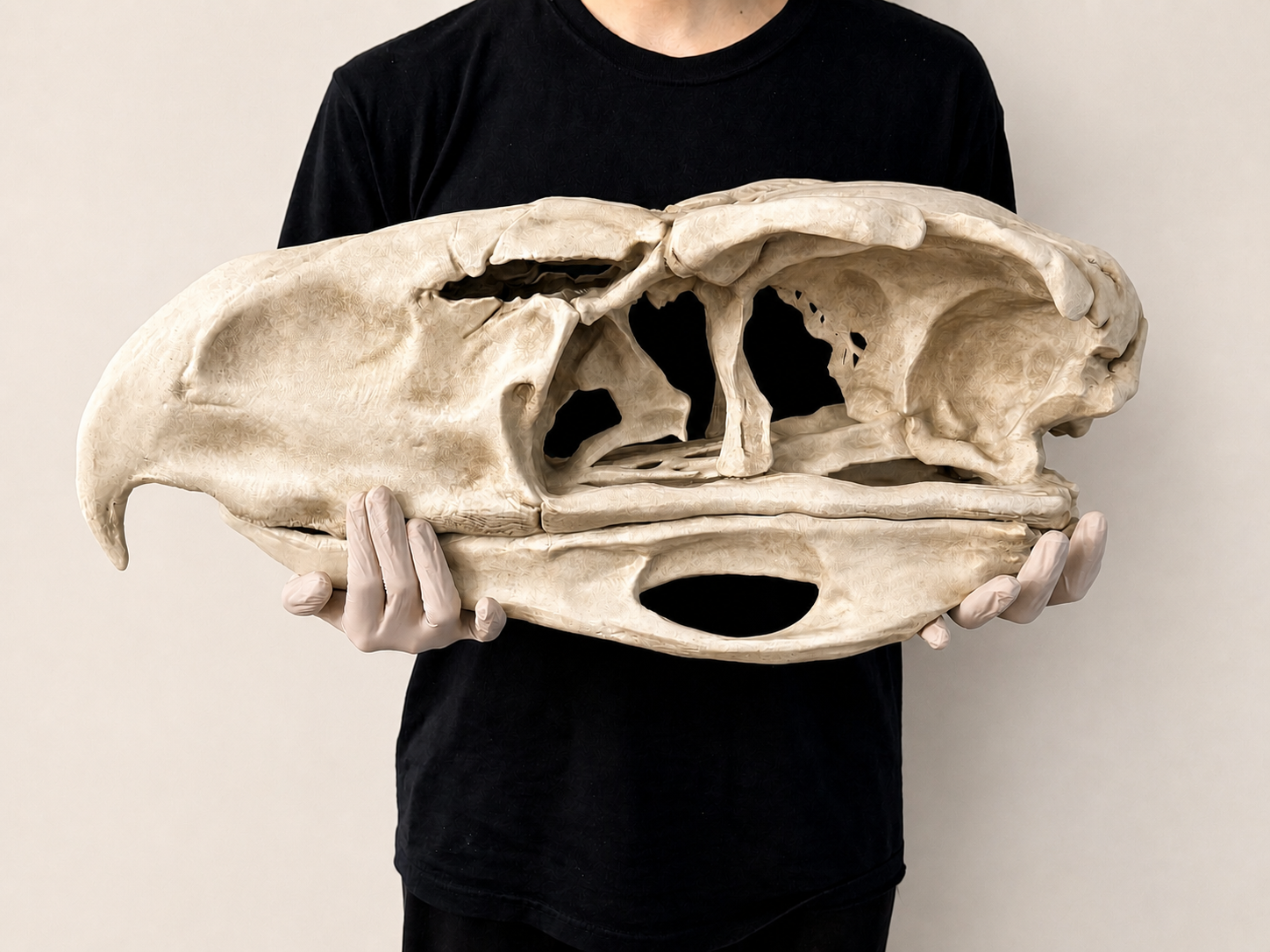
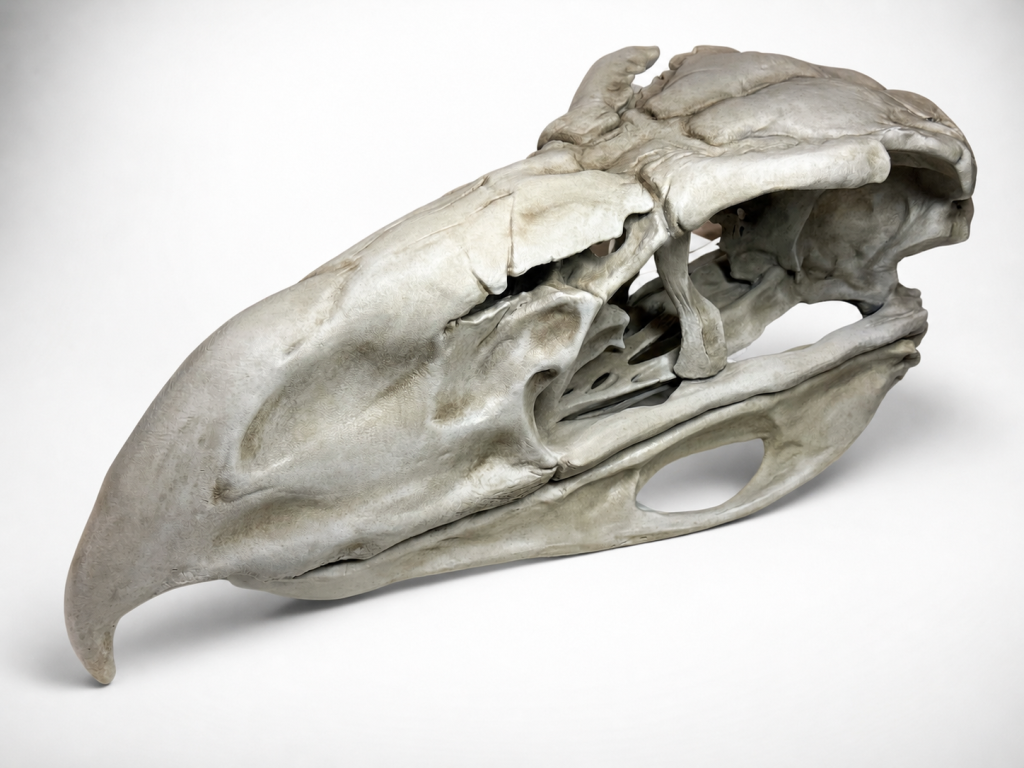
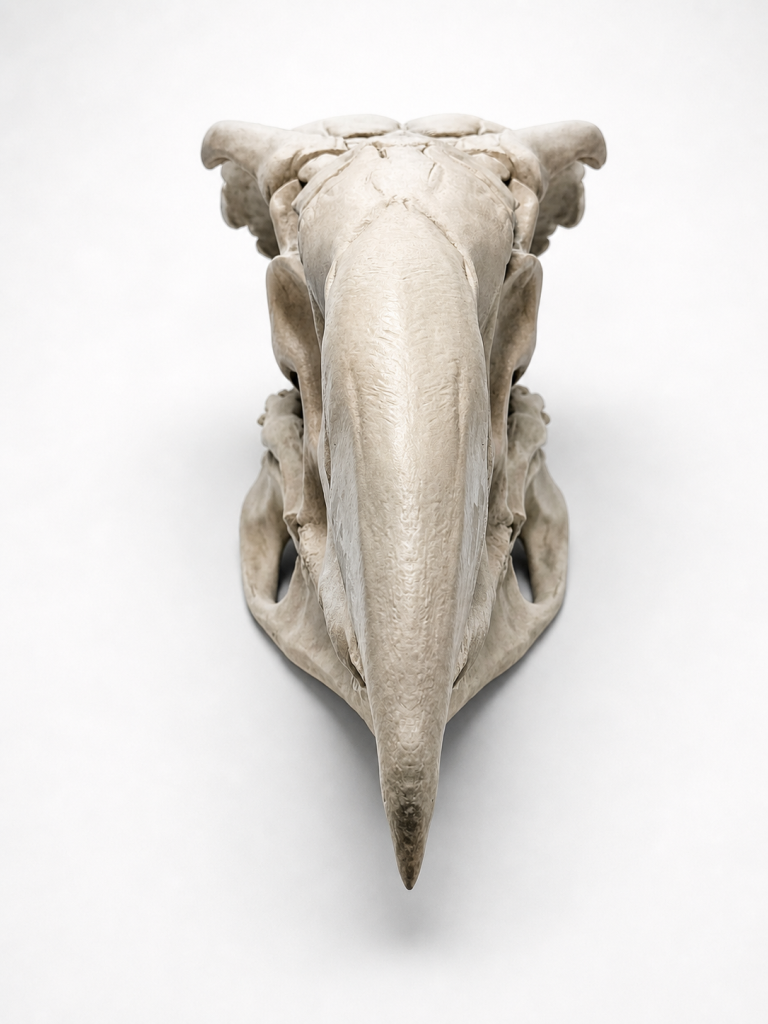
The skull is not merely large. It is decisive. It tells us that this was a bird whose head had become a weapon. The bill rises high from the face and narrows like a blade seen edge on. The upper jaw curves downward toward a hooked tip. The lower jaw stretches forward in a long fused symphysis. The eye would have sat behind this apparatus, not as the center of the head, but as the guide for a striking tool.
To make a replica of such a skull is to recreate one of the strangest predatory designs in the history of birds. Phorusrhacos longissimus lived in Patagonia during the early Miocene, roughly 16 to 18 million years ago, in a South America still isolated from the great northern continents. It belonged to the phorusrhacids, the famous terror birds. They were flightless, long legged, carnivorous birds that became major land predators across Cenozoic South America. Phorusrhacos was not the largest of them, but it was the animal that gave the group its name, and its skull remains one of the central clues to how these birds lived. [1], [2], [5]
A bird first mistaken for something else
The story began with a jaw. In 1887, Florentino Ameghino described a fossil from the Santa Cruz Formation of Patagonia as Phorusrhacos longissimus. The specimen was incomplete. It was a long, toothless lower jaw, and Ameghino first interpreted it as belonging to an edentulous mammal. That mistake is easy to forgive. Nothing like this lived in the modern world. The jaw was too long and deep for any familiar bird. It looked like the relic of an unknown beast.
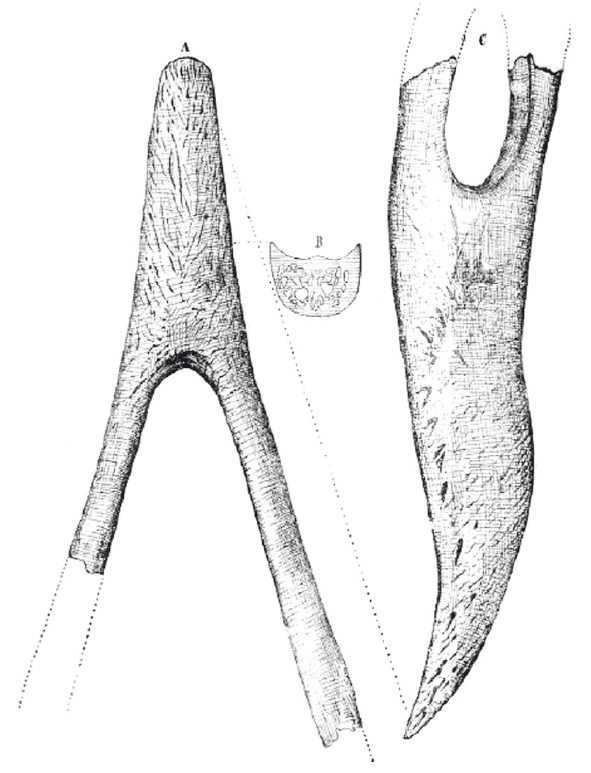
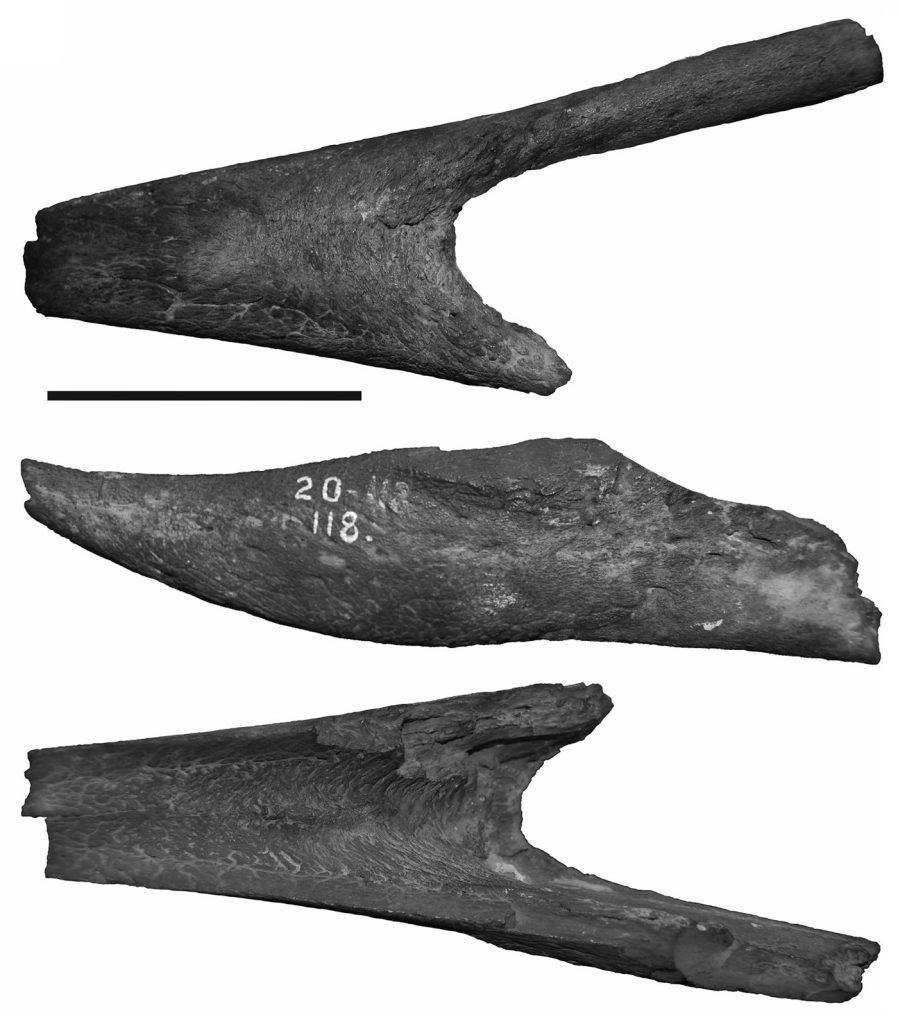
Only later did its avian nature become clear. By 1891, Phorusrhacos had been recognized as a bird, and the name began its long afterlife as the root of Phorusrhacidae. The original spelling, Phorusrhacos, has priority, although the alternative spelling Phororhacos appeared in later literature and gave rise to some nomenclatural confusion. [1], [2]
That first misreading is more than a historical curiosity. It tells us how far terror birds had moved from the ordinary bird shape. Their skulls had taken the light, kinetic, mobile architecture of a bird’s head and pushed it toward something heavier, stiffer, and more mammal like in predatory function. They were still birds in bone, feather, lung, egg, and ancestry. Yet their heads had crossed into a form no living bird fully repeats.
Extant relatives
The closest living relatives of phorusrhacids are the seriemas of South America, the red legged seriema and the black legged seriema. Seriemas are not miniature terror birds, but they are the nearest living window into the group. They are long legged terrestrial birds. They run well. They eat insects, lizards, snakes, small mammals, young birds, and other animal prey. They kill some prey by seizing and striking it against the ground.
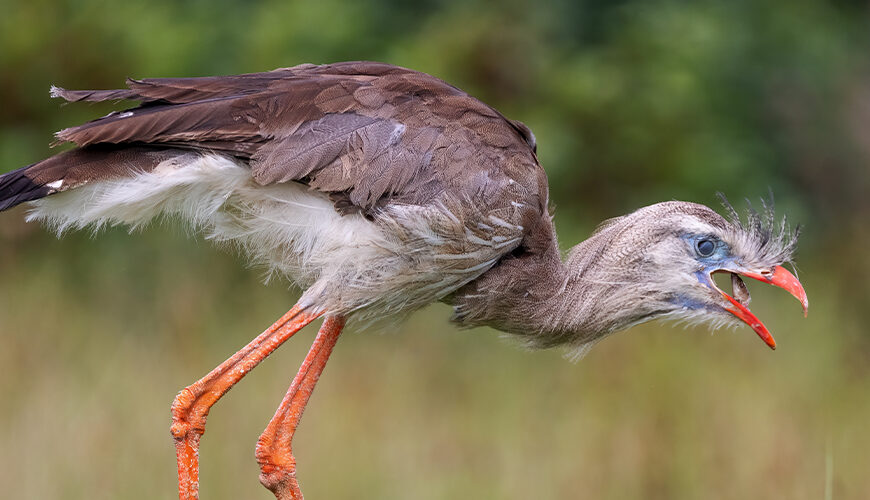
The relationship matters because it keeps Phorusrhacos in the right part of the bird tree. Terror birds were not giant hawks. They were not cranes turned carnivorous. They belonged to the Cariamiformes, a lineage whose living survivors are seriemas. Raptors show what sharp talons and hooked bills can do in flight. Seriemas show a different route into predation. They suggest a bird hunting with long legs, a long neck, a stabbing head, and quick terrestrial movement. [2], [3], [9], [10]
Yet the gap between a seriema and Phorusrhacos is vast. A red legged seriema weighs between 1.2 and 3 kilograms. Phorusrhacos exceeded 100 kilograms. The living seriema gives us the family accent. It does not give us the full voice.
Description of the animal
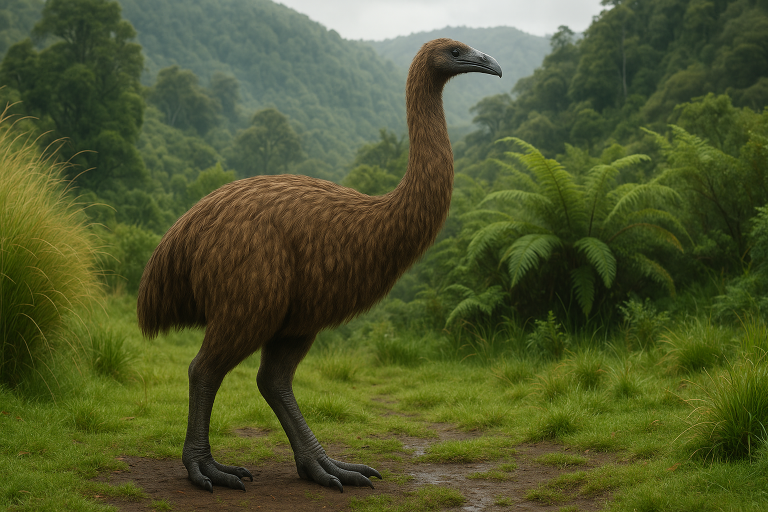
Phorusrhacos longissimus was a large flightless bird from the Santa Cruz Formation of southern Argentina. It is commonly imagined as standing roughly as high as a person or taller, with a deep body, reduced wings, a long neck, powerful legs, and a head that appears almost too large for the frame carrying it. The safest published estimate places its body mass above 100 kilograms. [2], [5]
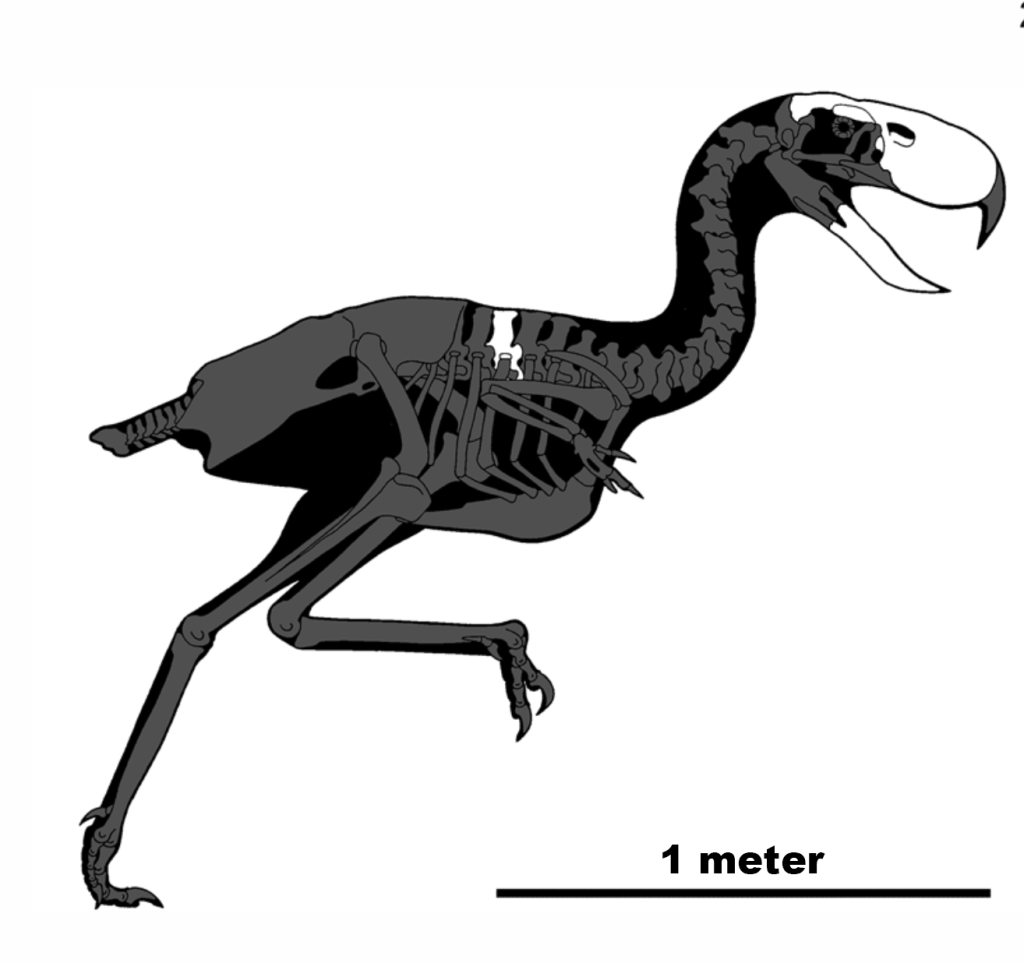
The name longissimus suits it. The animal was long in limb, long in jaw, long in stride. Its body plan was built around terrestrial movement. It had no need of the air. Its wings were reduced. Its power was carried through the hips and legs, through the neck, and finally into the skull.
Large phorusrhacids are often described as cursorial predators. That word can mislead if it conjures a cheetah like sprint across open plain. A better image is a large bird able to cover ground efficiently, accelerate in short bursts, pivot with the head held ready, and use the skull as the main killing organ. The feet mattered. The body mattered. But the skull was the final instrument.
The skull as a predatory machine
The known skull remains of Phorusrhacos are incomplete, but they are eloquent. The most important recent material, MPEF PV 11356, preserves much of the rostrum, skull roof, orbit region, and mandible. It confirms that Phorusrhacos had the classic large terror bird skull form. The beak was tall, narrow from side to side, and strongly built. The preserved rostrum is estimated at about 52 centimeters long. Older field drawings of a now mostly lost skull suggested a total skull length of about 65 centimeters. [2]
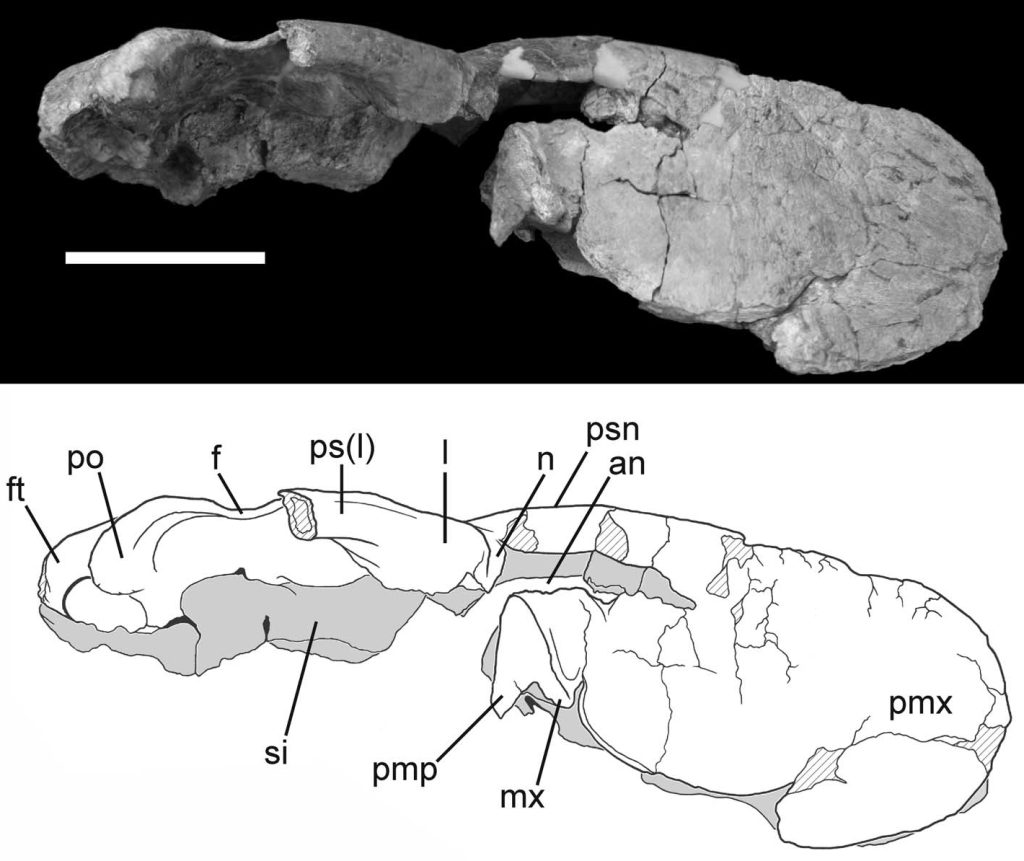
That means the skull alone approached the length of a human arm. This was not a delicate probing bill. It was a deep, compressed structure, like a hatchet made of bone and keratin.
Several features stand out. The premaxilla, the front bone of the upper bill, was robust and high. The sides of the rostrum preserve grooves and pits for nerves and blood vessels. These would have supplied the keratin covering of the beak, making the living bill a sensitive structure rather than a dead weapon. The cutting edges of the jaws were falcate, or sickle like, and the missing tip of the upper bill is inferred to have curved downward into a hook. [2]
The mandible was also unusual. Its fused front portion, the symphysis, was long and narrow. In referred material and comparisons, the symphysis is more than twice as long as it is wide. That long fused section would have strengthened the front of the lower jaw and helped it resist the forces produced when the bird struck, grasped, or pulled. [2]
The skull was also highly compressed from side to side. Seen from the front, it would have looked narrow. Seen from the side, it would have looked immense. This is one of the great principles of the terror bird head. It made the skull deep enough to resist vertical loading, while keeping the cutting profile narrow.
A stiff skull, not a flexible one
Most birds have skulls with some degree of cranial kinesis. In simple terms, parts of the upper bill can move relative to the braincase. This mobility is useful for feeding, manipulating food, and reducing forces through the skull.
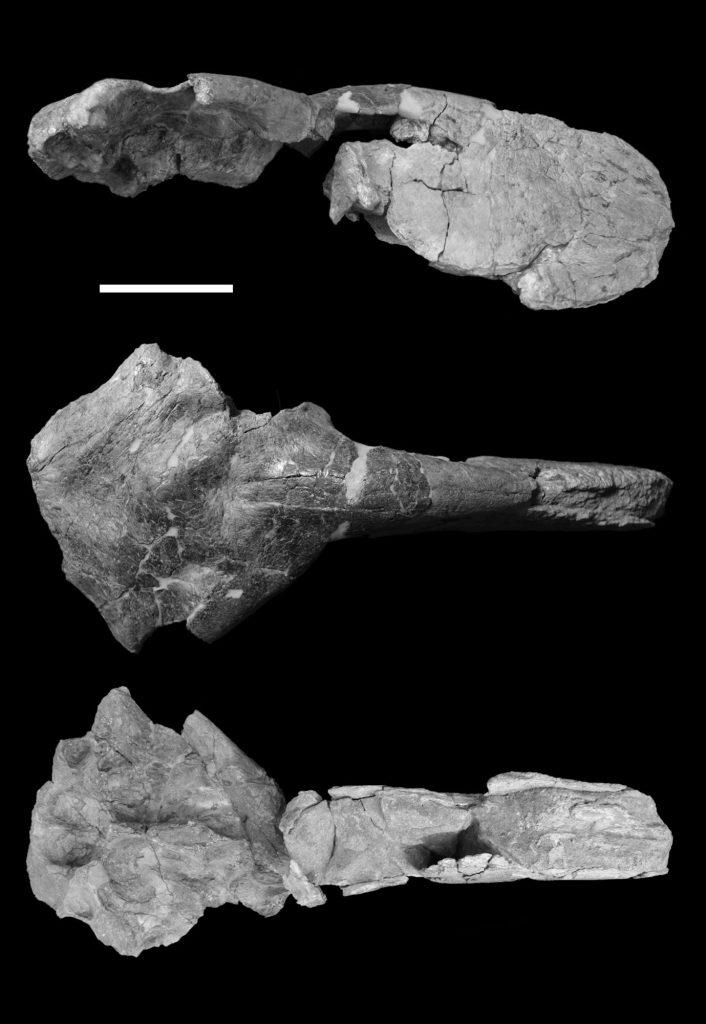
Terror birds went in the opposite direction. In phorusrhacids, the usual bending zones of the avian skull were reduced or functionally lost. The skull became akinetic. It did not flex in the way many bird skulls do. The bones around the beak and face thickened, fused, or locked into a rigid structure. [3], [4]
This matters greatly for interpreting Phorusrhacos. A mobile skull is good for delicate manipulation. A stiff skull is better for impact. The terror bird skull was not designed to nibble, pry in many directions, or wrestle sideways with a large struggling animal. It was designed to deliver and withstand force along particular axes.
Biomechanical work on Andalgalornis, a smaller but similarly deep skulled phorusrhacid, gives the best functional model. CT based and finite element analyses found that its skull handled vertical biting and pulling forces much better than lateral forces. The skull was weak under sideways loading, but strong when forces acted up and down through the sagittal plane. The authors argued that such a bird probably avoided prolonged struggles with large prey and instead used targeted, repeated strikes, or swallowed smaller prey whole. [3]
We should not simply copy every detail from Andalgalornis onto Phorusrhacos. They were different animals. But the broad skull architecture is close enough to make the comparison useful. The message is clear. The terror bird head was a vertical weapon. It was a beak for stabbing, chopping, hooking, and tearing in line with the body. It was not a clamp for wrestling sideways like the jaws of a mammalian carnivore.
Hunting habits
Imagine Phorusrhacos in the Santa Cruz landscape. Not a barren plain. Not a dense rainforest. More likely a shifting mosaic of open ground, shrubland, wooded patches, and wetlands under a seasonal climate. There were grazing and browsing mammals, small vertebrates, armadillo like forms, native ungulates, rodents, marsupials, and other birds. The land was full of bodies that did not know placental cats, dogs, bears, or hyenas. South America had evolved its own predatory cast. [6], [7], [8]
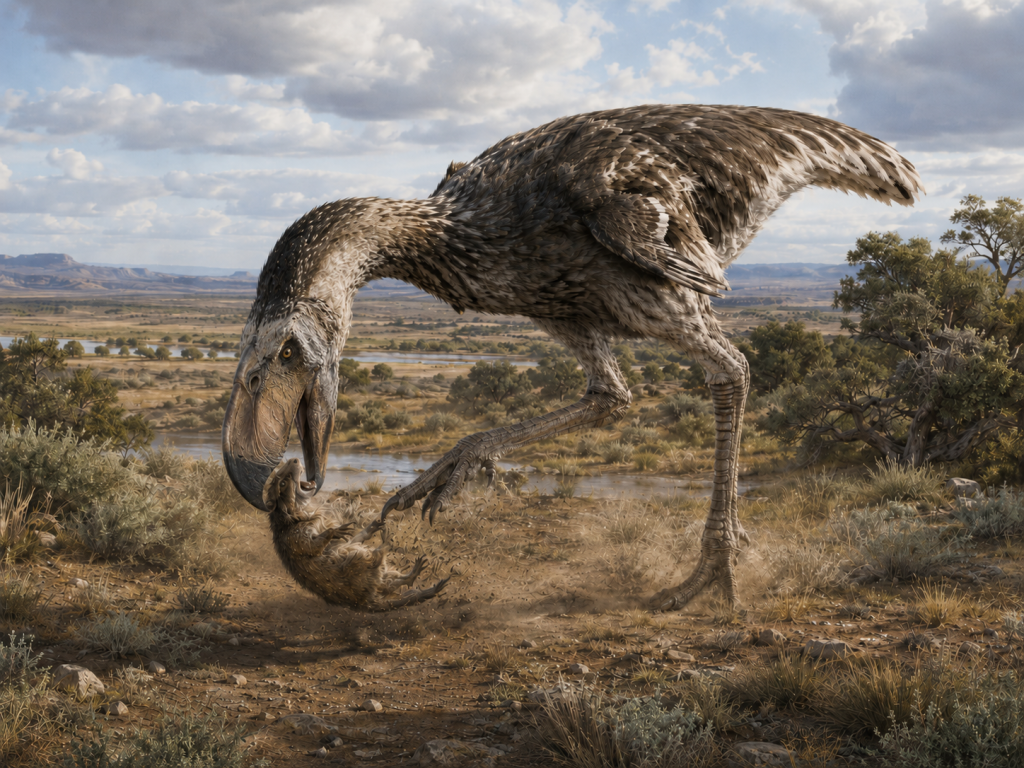
In that world, Phorusrhacos may have hunted by walking, watching, and closing distance with sudden speed. Its height gave it a wide field of view. Its long legs allowed efficient movement through open patches. Its neck could bring the skull down in a rapid arc. For small prey, the bird may have seized and swallowed the animal whole, as many living predatory birds do. For larger prey, the beak could have delivered repeated blows to the head, neck, back, or flank.
The hook of the bill may have helped hold or tear. The cutting edges may have opened flesh. The stiff skull may have allowed the bird to strike with the beak like a pick, then withdraw before the prey could twist the head sideways. This attack and retreat style fits the mechanical evidence better than the image of a terror bird locking onto a large animal and wrestling it to the ground. [3]
The legs may also have played a role. Living seriemas can kick, run, seize, and beat prey against the ground. Large terror birds probably used their feet for balance, restraint, positioning, and perhaps striking. But their toes were not the great grasping talons of eagles. The skull remained the signature weapon.
Scavenging is also plausible. Most large predators scavenge when opportunity allows. A carcass in the open would have been a gift. The high bill and strong neck could have opened flesh, pulled tissue, and displaced smaller scavengers. But the skull of Phorusrhacos does not look like the skull of a bird reduced to scavenging alone. It looks like the skull of an active hunter that would not refuse carrion.
Other behavior
The behavior of Phorusrhacos has to be reconstructed cautiously. No trackway, nest, egg, or soft tissue can yet be assigned to the species with confidence. But anatomy, living relatives, and ecology allow some careful possibilities.
It was probably visually alert. A tall terrestrial predator with a long neck and deep skull would have spent much of its time scanning. The head may have moved in quick corrections, as seen in many ground birds. Seriemas, rheas, bustards, cranes, and secretary birds all show how much information a terrestrial bird gathers by pausing, looking, walking, then striking.
It may have defended territories or large home ranges. Living seriemas use loud calls and pair behavior. At least one later phorusrhacid, Llallawavis, has been interpreted as having hearing tuned toward relatively low frequencies, which may suggest communication over distance in open habitats. We cannot know the call of Phorusrhacos, but a large land bird in an open or semi open landscape would have benefited from sound that carried. [9]
Social life is even harder to infer. It may have hunted alone. It may have formed pairs. Family groups are possible during breeding and chick rearing. The living seriema model supports pair bonding and biparental care, but the scale of Phorusrhacos changes the setting.
The skull also hints at display. In life, it would have been covered by a keratinous sheath. That sheath may have had color, texture, or contrast. Large birds often use bare skin, beaks, crests, or posture in social signaling. A skull this prominent would not have been invisible in courtship or territorial encounters. The living bird may have raised and lowered that huge head in ritualized threat, recognition, and display.
Breeding and nesting behavior
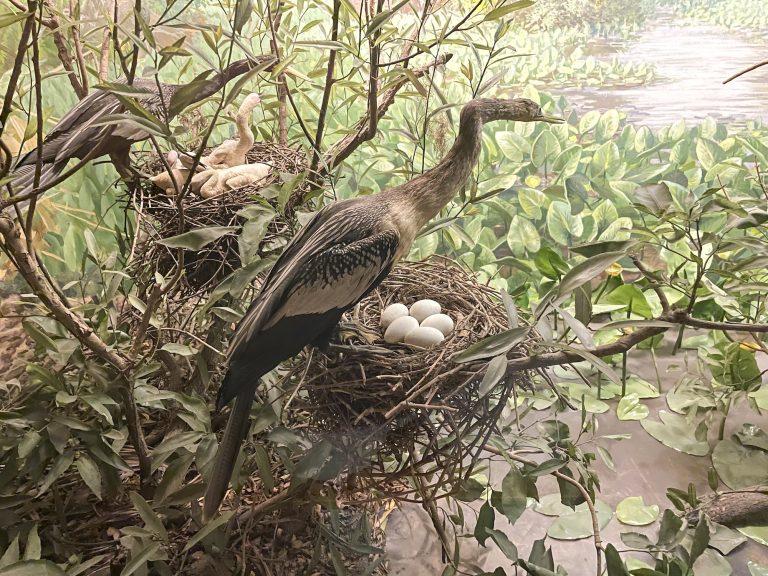
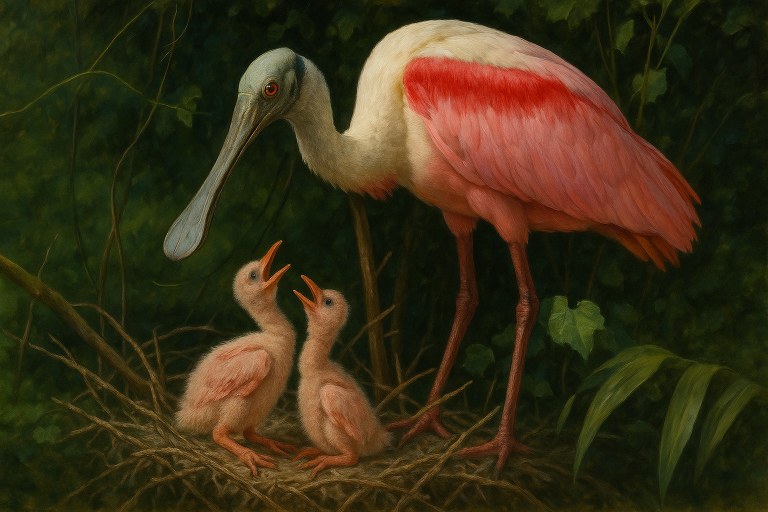
No confirmed Phorusrhacos nest or egg is known. The best living comparison is, again, the seriema. Red legged seriemas build nests of twigs and branches, often in trees or shrubs a few meters above the ground. They usually lay two or three pale eggs that are lightly spotted. Both sexes incubate. The chicks hatch downy, with eyes open, but they are not instantly independent runners. They remain dependent and develop in the nest before leaving. [10]
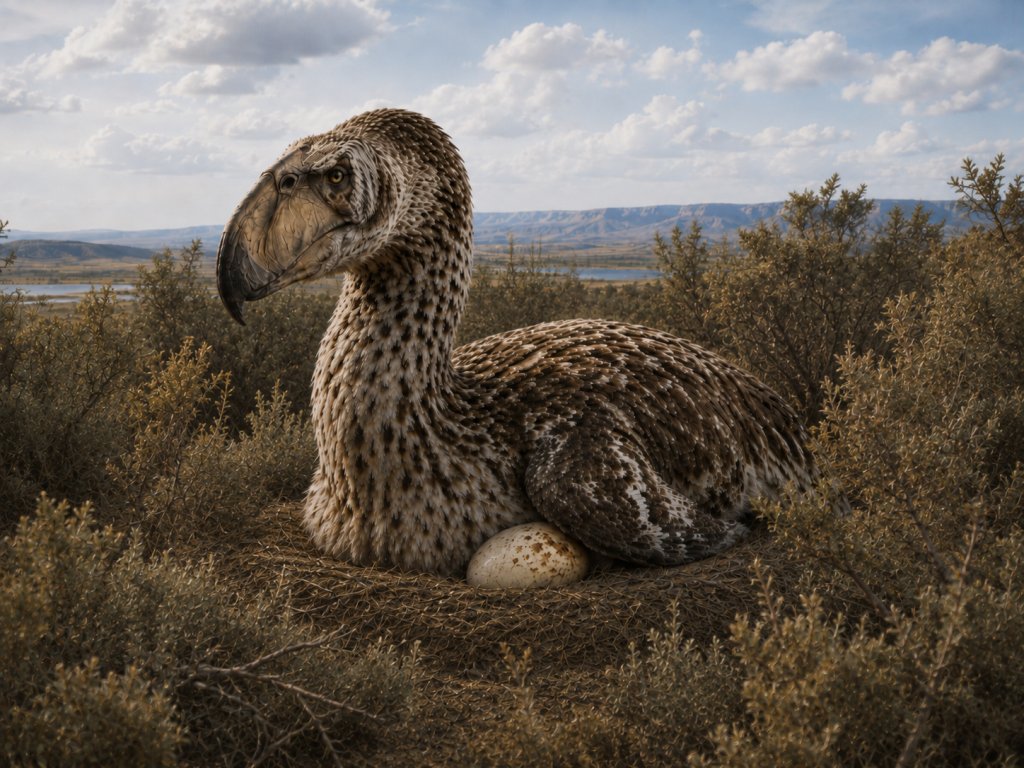
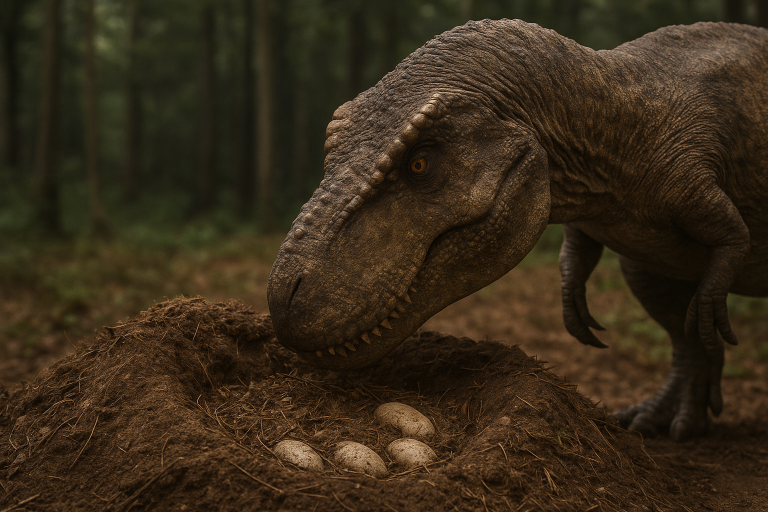
A bird the size of Phorusrhacos almost certainly could not have nested high in trees in the manner of a seriema. Its body mass changes the problem. The nest was more likely on the ground, on a low rise, in dense vegetation, against a bank, among shrubs, or in some other protected low site. It may have been a broad platform of vegetation rather than a simple scrape. A large egg on the ground is vulnerable. A large adult standing over it is a powerful defense.
Incubation may have involved both parents, if the seriema comparison holds. A huge bird sitting on eggs must solve a delicate problem. It has to warm the egg without crushing it. Large ratites solve this with body posture, nest structure, and careful turning. Phorusrhacos may have done the same.
Chick development is uncertain. Since seriemas have dependent chicks, it is possible that terror bird chicks were cared for in a nest or nearby shelter for some time rather than simply running off like tiny rheas. Yet large flightless birds often move toward more ground based, mobile young. The safest conclusion is that Phorusrhacos probably had substantial parental care, but the exact degree of chick mobility remains unknown.
Egg size, shape, and coloration
The egg of Phorusrhacos longissimus has not been found. Any estimate has to be built from body size, avian egg scaling, and the eggs of living relatives.
Using broad bird egg allometry, a bird above 100 kilograms would be expected to lay an egg of roughly 2.0 kilograms or more. If body mass is placed in the 100 to 130 kilogram range, the estimate rises to about 2.0 to 2.4 kilograms. [11]
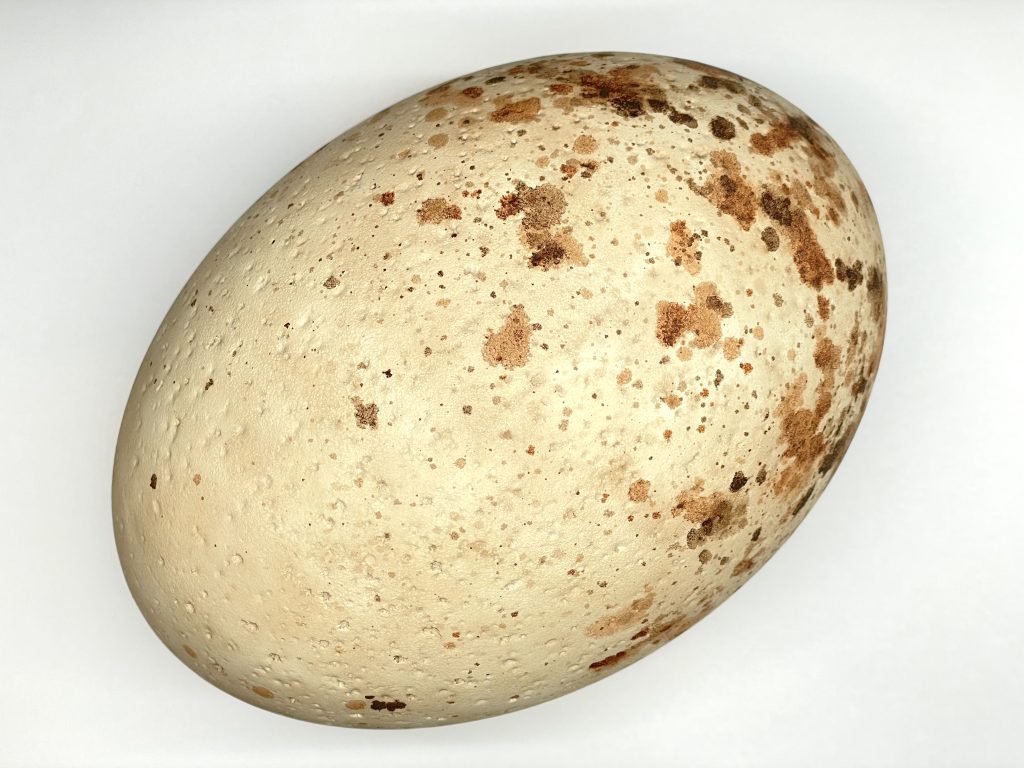
To turn that mass into dimensions, Hoyt’s egg volume and fresh weight relationships are useful. If the egg was a large oval with a length to breadth ratio of roughly 1.2 to 1.4, then a reasonable estimate would be about 17 to 19 centimeters long and about 12 to 15 centimeters wide. It would have been far smaller than the egg of an elephant bird, but far larger than an ostrich egg in mass if the upper estimates are used. [12]
The shape was probably oval to slightly elongate oval. A very pointed egg is less likely for such a large ground nesting bird, unless nest architecture selected for it. A more stable oval form would make sense for incubation and turning.
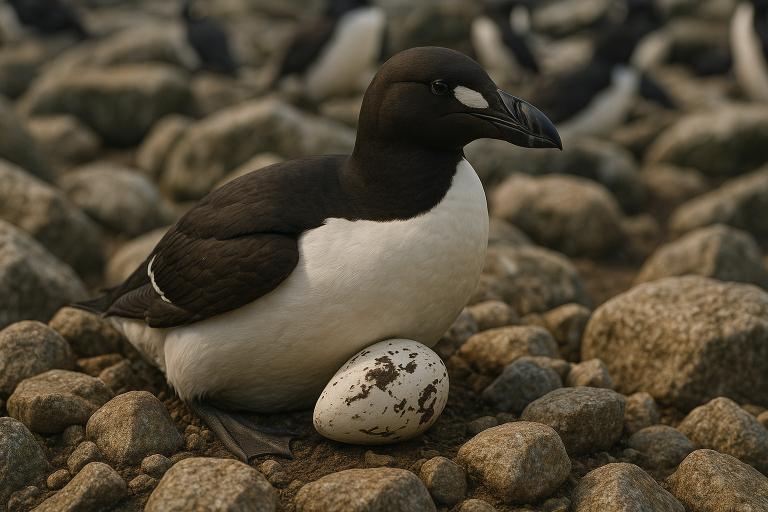
Color is the most speculative part. Seriema eggs are described as white or pale and slightly spotted. [10] If Phorusrhacos had a similar egg appearance, its eggs may have been pale cream, chalky white, or warm buff, with sparse reddish brown, purplish, or grayish markings. If it nested on the ground in open cover, stronger camouflage would be advantageous. In that case, the egg may have carried more mottling, especially around one end. If it nested in a concealed platform and was closely guarded, pale eggs with light spotting are just as plausible.
For a replica, I avoided making the egg too colorful. A convincing Phorusrhacos egg would be large, heavy looking, matte to softly satin, pale cream with restrained reddish brown speckling.
Ecology of the Santa Cruz world
The Santa Cruz Formation preserves one of the great Miocene faunas of South America. It records a world of strange native mammals, large birds, wetlands, open habitats, and wooded patches. Reconstructions vary, but the environment is often described as a mixed landscape rather than a single uniform habitat. There were grassland elements, woodland elements, and water associated habitats. Some authors have compared parts of the setting to a park savanna or a Chaco like mosaic. [6], [7]
This matters for Phorusrhacos. A deep skulled, long legged predator does not need an empty plain. It needs visibility, room to move, and enough cover to approach prey. Open woodland, scrub, river margins, and patches of grassland would have provided all of that.
The Santa Cruz avifauna included several phorusrhacids. In some accounts, phorusrhacids outnumber seriemas and raptorial birds in both diversity and abundance. That suggests that terror birds were not rare oddities on the edge of the ecosystem. They were part of the central predatory structure. [6]
Phorusrhacos likely hunted among herbivorous mammals and smaller vertebrates. It shared the broader carnivore guild with sparassodonts, the native South American metatherian predators often compared in ecological role to placental carnivores. This was not a simple world where terror birds ruled alone. It was a divided predatory landscape, with different hunters taking different prey in different ways. [3], [8]
Extinction
Phorusrhacos longissimus belongs to the early Miocene record. Its disappearance was not the final extinction of terror birds. It was the disappearance of one species from one chapter of a much longer history.
Phorusrhacids persisted for tens of millions of years. They spread through South America and, after the formation of land connections between the Americas, at least some reached North America. The North American terror bird Titanis survived into the Pliocene. Other phorusrhacid remains suggest survival in South America far later, perhaps near the end of the Pleistocene in Uruguay. [13], [14]
This long persistence weakens the old simple story that terror birds vanished immediately because northern placental carnivores invaded South America and outcompeted them. Competition may have mattered in some places and times. Environmental change may have mattered. Prey change, climate, habitat shifts, reproductive limits, and chance may all have mattered. But the group did not fall in a single dramatic defeat.
For Phorusrhacos itself, extinction probably meant ecological replacement and lineage turnover within a changing Miocene world. Its skull was successful, but no skull design lasts forever. Landscapes change. Prey communities change. Other predators change. The great head that once made the bird formidable eventually became a fossil, then a drawing, then a museum specimen, then a replica held in the hand.
Museum specimens, especially skulls
The skull history of Phorusrhacos is particularly important because the animal was named from jaw material, and because early skull finds were fragile.
The holotype is the lower jaw from the Santa Cruz Formation, housed at the Museo de La Plata in Argentina. Degrange and colleagues list the type specimen as MLP 20 122, although related older numbering and table references can create confusion in the literature. This lower jaw is the foundation of the species. [2]
Another historically important specimen is NHMUK A529 at the Natural History Museum, London. Carlos Ameghino reportedly found skull material in the field, but the original skull was embedded in crumbling rock and was too friable to preserve completely. It survived long enough to be sketched and briefly described, but much of the material was lost or reduced to fragments. Those early drawings became important evidence for the skull form of Phorusrhacos. [2]
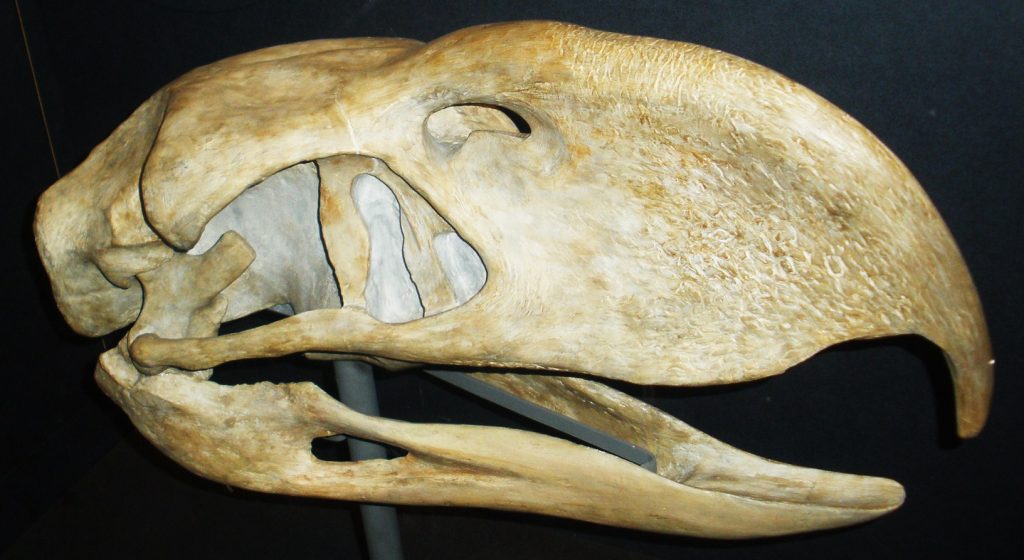
The most important recent skull material is MPEF PV 11356 at the Museo Paleontológico Egidio Feruglio in Trelew, Argentina. It preserves a large part of the rostrum, skull roof, orbit region, and associated mandible. This specimen allowed researchers to revisit the anatomy of Phorusrhacos with much better evidence than the old drawings alone. It confirmed the tall, narrow, heavy rostrum and clarified several cranial traits that link the specimen to Phorusrhacos longissimus. [2]
Other institutions hold phorusrhacid material useful for comparison, including major collections in Argentina, the United States, and the United Kingdom. The Field Museum, Yale Peabody Museum, the American Museum of Natural History, the Museo de La Plata, the Museo Tradicional Lorenzo Scaglia, and the Museo Paleontológico Egidio Feruglio all appear in the comparative research history of this group. [2]
Skull casts and reconstructions can also be found in museum displays. These are important for public understanding, even when they are not original fossils. A well made skull replica is not just an ornament. It is a way of restoring the argument of the bones. It shows the height of the bill, the narrowness of the face, the long jaw, and the strange balance between bird and beast.
Why the skull matters
The skull of Phorusrhacos longissimus records a bird lineage that found a predatory solution different from the talons of eagles and the teeth of cats. It shows how evolution can take the avian skull, usually light and kinetic, and make it stiff, deep, and forceful. It shows that a bird can become a terrestrial hunter not by imitating mammals, but by exaggerating bird anatomy in its own direction.
The beak was not a tooth row. It did not chew. It did not grip like a wolf’s jaw. It struck, hooked, cut, and withdrew. The skull was a weapon with rules. Strong in one direction. Vulnerable in another. Terrible when used correctly.
That is what makes Phorusrhacos so compelling. It was not merely big. It was specialized. Its skull was the center of an entire way of life. In that long Patagonian head, we see a predator built by isolation, opportunity, and the deep inventiveness of birds.
References
- Buffetaut, Eric. 2013. “Phororhacoidea or Phorusrhacoidea? A Note on the Nomenclature of the ‘Terror Birds.’” Annales de Paléontologie 99.
- Degrange, Federico J., Drew R. Eddy, Pablo Puerta, and Julia A. Clarke. 2019. “New Skull Remains of Phorusrhacos longissimus Ameghino, 1887 from the Early Miocene of Patagonia.” Journal of Paleontology 93, no. 6: 1221–1233.
- Degrange, Federico J., Claudia P. Tambussi, Karen Moreno, Lawrence M. Witmer, and Stephen Wroe. 2010. “Mechanical Analysis of Feeding Behavior in the Extinct ‘Terror Bird’ Andalgalornis steulleti.” PLOS ONE 5, no. 8: e11856.
- Degrange, Federico J. 2025. “Reversing the Trend: The Evolution of Cranial Akinesis in the Terror Birds, Phorusrhacids.” Fossil Studies 3.
- LaBarge, Thomas W., Jacob D. Gardner, and Chris L. Organ. 2024. “The Evolution and Ecology of Gigantism in Terror Birds.” Proceedings of the Royal Society B 291: 20240235.
- Degrange, Federico J., Julia I. Noriega, and Juan I. Areta. 2012. “Diversity and Paleobiology of the Santacrucian Birds.” In Early Miocene Paleobiology in Patagonia: High Latitude Paleocommunities of the Santa Cruz Formation, edited by Sergio F. Vizcaíno, Richard F. Kay, and M. Susana Bargo. Cambridge: Cambridge University Press.
- Vizcaíno, Sergio F., M. Susana Bargo, Richard F. Kay, Richard A. Fariña, and Mariana Di Giacomo. 2010. “A Baseline Paleoecological Study for the Santa Cruz Formation, Late Early Miocene, at the Atlantic Coast of Patagonia, Argentina.” Palaeogeography, Palaeoclimatology, Palaeoecology 292: 507–519.
- Prevosti, Francisco J., Analía M. Forasiepi, Marcos D. Ercoli, and Guillermo F. Turazzini. 2012. “Paleoecology of the Mammalian Carnivores of the Santa Cruz Formation.” In Early Miocene Paleobiology in Patagonia: High Latitude Paleocommunities of the Santa Cruz Formation, edited by Sergio F. Vizcaíno, Richard F. Kay, and M. Susana Bargo. Cambridge: Cambridge University Press.
- Degrange, Federico J. 2015. “Terror Bird: New Species Unveiled.” Florida Museum of Natural History.
- Hallager, Sara. 2013. Red Legged Seriema Care Manual. Silver Spring, MD: Association of Zoos and Aquariums. Also Hallager, Sara. 2013. North American Studbook for the Red Legged Seriema. Smithsonian National Zoological Park.
- Rahn, Hermann, C. V. Paganelli, and Amos Ar. 1975. “Relation of Avian Egg Weight to Body Weight.” The Auk 92: 750–765.
- Hoyt, Donald F. 1979. “Practical Methods of Estimating Volume and Fresh Weight of Bird Eggs.” The Auk 96, no. 1: 73–77.
- Jones, Washington, Andrés Rinderknecht, Herculano Alvarenga, Felipe Montenegro, and Martín Ubilla. 2018. “The Last Terror Birds, Phorusrhacids, from the Late Pleistocene of Uruguay.” PalZ 92: 365–372.
- MacFadden, Bruce J., Joann Labs Hochstein, Richard C. Hulbert Jr., and Jon A. Baskin. 2007. “Revised Age of the Late Neogene Terror Bird Titanis in North America during the Great American Interchange.” Geology 35, no. 2: 123–126.