Pelagornis sandersi: Reconstructing Egg and Nesting Characteristics
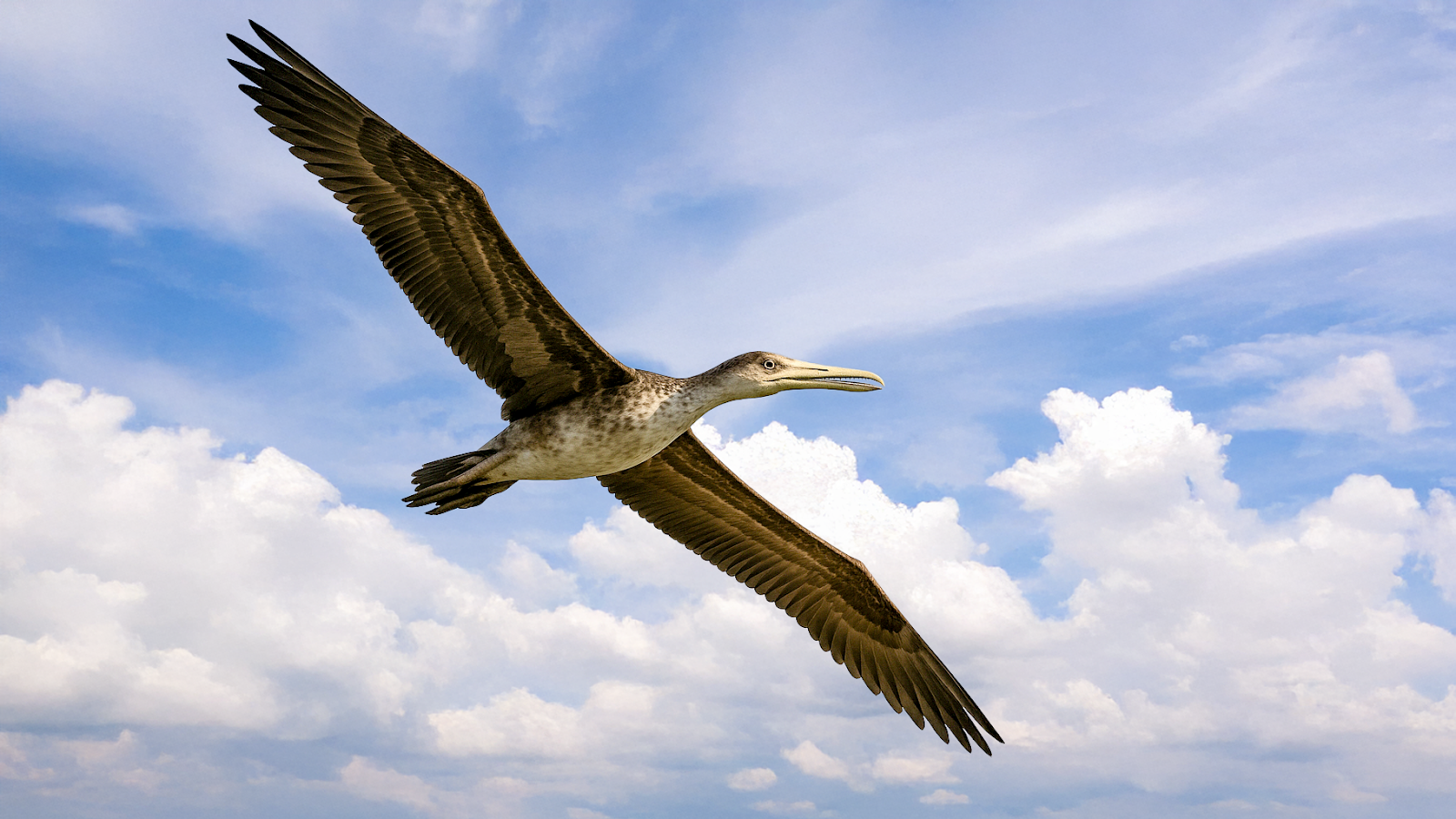
Pelagornis sandersi was a giant bony-toothed seabird known from the Oligocene epoch and among the largest flying birds ever discovered. No fossil eggs or nests of P. sandersi have been found, but we can infer its reproductive traits by analogy with modern seabirds such as albatrosses and pelicans and other large extinct birds such as Argentavis, Ichthyornis and Hesperornis. This article synthesizes paleontological evidence and biological comparisons to reconstruct the likely size, shape, texture, and coloration of a Pelagornis sandersi egg. Key aspects of nesting, including site selection, clutch size, parental care, and incubation strategy, are discussed in light of Eocene-Oligocene coastal environments and climate-driven adaptations. Each inference is grounded in known data from fossils or living analogs.
Inferred Egg Characteristics of Pelagornis sandersi
Egg Size and Shape
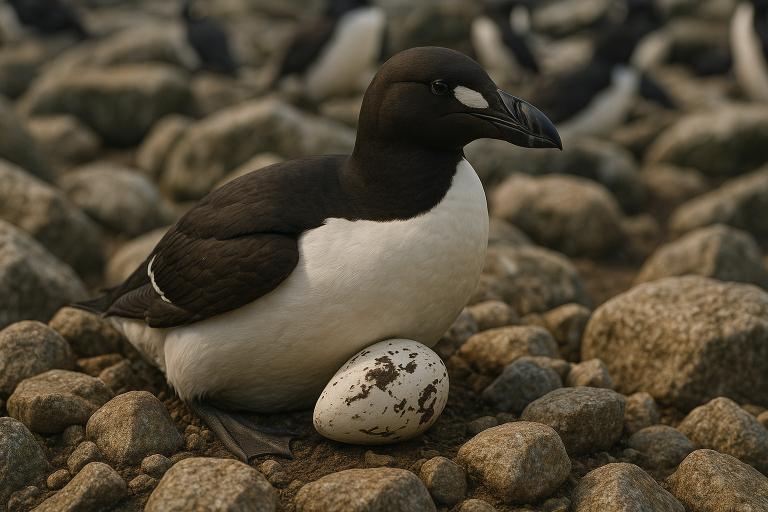
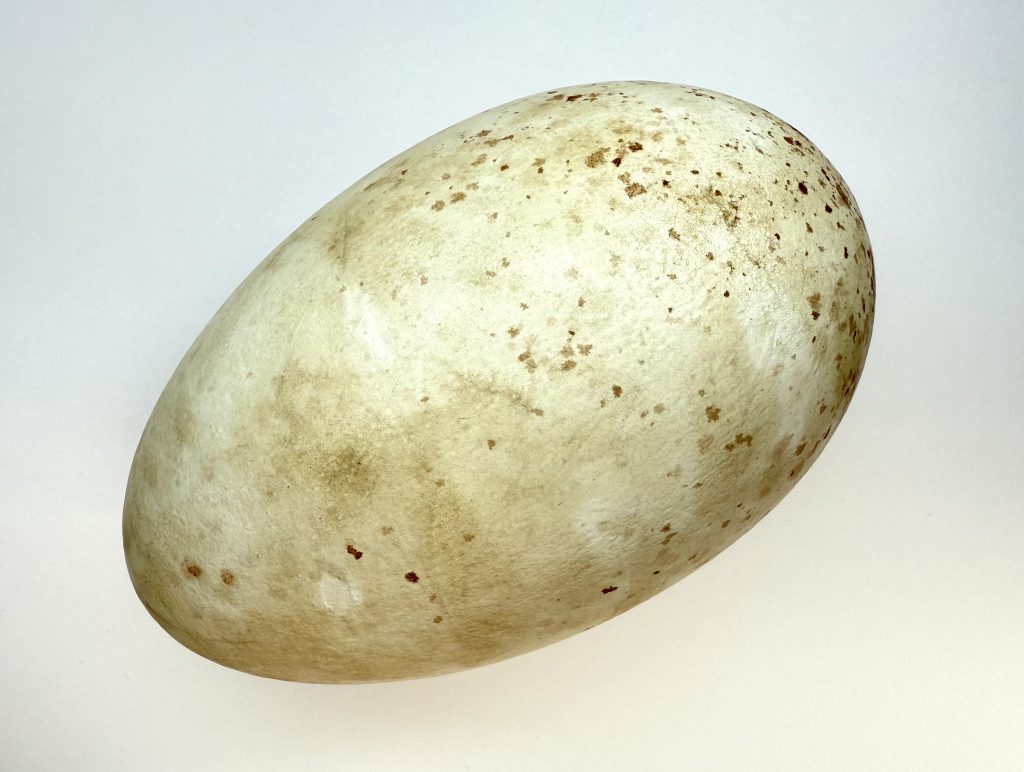
With an estimated wingspan of 6.1–7.4 m and body mass of 22–40 kg, Pelagornis sandersi would have produced a very large egg. It was likely comparable in length to the eggs of the largest modern birds, though somewhat smaller than an ostrich egg. By comparison, the wandering albatross (Diomedea exulans) weighs ~8–10 kg and lays a single egg ~10–13 cm long, weighing up to 0.5 kg. The extinct giant teratorn Argentavis (≈70 kg) is inferred to have laid one or two eggs around 1 kg each being somewhat smaller than an ostrich’s. Pelagornis, being intermediate in mass, might have laid an egg roughly on the order of 12–15 cm in length and perhaps 0.5–1.0 kg in weight, placing it among the largest seabird eggs ever. The shape was likely sub-elliptical, i.e. elongated oval with slightly tapered ends. Most ground-nesting seabirds produce eggs that are not perfectly round. A gently tapered end would have helped prevent the egg from rolling away and allowed it to fit under the parent’s body. For example, albatross eggs are elongated ovals, and pelicans’ eggs are similarly oval. It is unlikely that P. sandersi eggs were as extremely pointy as those of cliff-nesting birds (e.g. murres), since Pelagornis probably did not nest on narrow ledges (see below). Instead, the egg was probably proportionally similar to albatross or stork eggs, but scaled up in size.
Eggshell Structure and Texture
The eggshell of Pelagornis sandersi would need to balance strength and weight. Large birds often have thick, robust eggshells to support the weight of incubating parents, yet thin enough to allow hatching. Fossil evidence tentatively supports thick-shelled eggs for pelagornithids: fragmentary giant eggshells from the Late Miocene of Lanzarote (Canary Islands) have been attributed to pseudotooth birds, suggesting these birds produced sizeable, strong eggs. The shell was likely textured similar to those of large seabirds and waterbirds. Many oceanic birds such as albatrosses and petrels, have a somewhat smooth but dull eggshell, while pelicans and cormorants lay eggs with a chalky, matte coating. Modern pelican eggs, for instance, are chalky white with a coarse, granular surface that becomes soiled during incubation. This chalky layer is a calcareous deposit that can flake or become stained, an adaptation seen in waterbird eggs to protect against wet nesting conditions. It is plausible that P. sandersi eggs had a similar matte, off-white shell with a slightly coarse texture, given its likely phylogenetic proximity to either pelicans or waterfowl. A chalky exterior would have helped camouflage any slight color and provided insulation, and it would be consistent with an egg kept in a ground nest where dirt and guano could accumulate. Internally, the shell thickness was probably considerable for a bird of this size. This would prevent crushing under the parent’s weight, but as with all bird eggs, would still allow the chick to pip out.
Egg Coloration and Markings
The coloration of Pelagornis sandersi’s eggs was likely muted, as is typical for ground-nesting seabirds. Because P. sandersi likely nested on isolated oceanic islands or predator-free coastal bluffs (see Nesting Behavior below), its eggs may not have required heavy camouflage. Many large seabirds that breed in secure colonies have largely white or off-white eggs. For example, albatross eggs are white with a few pale reddish-brown spots or speckles, usually concentrated at the larger end. Pelican eggs are unmarked dull white but quickly become dirt-stained. It is reasonable to infer Pelagornis eggs were white or cream-colored, perhaps with sparse freckles or mottling. A subtle speckling could provide minor camouflage against soil or vegetation, while a light base color prevents overheating in the sun. Given a likely open nest and continuous parental attendance, elaborate camouflage was probably unnecessary. Any markings present would have been fine and blotchy rather than bold. The eggshell’s chalky white coating (as hypothesized above) would itself appear dull gray-white. Over the course of incubation, the egg would become stained by soil and natural wear, further blending into the surroundings. In summary, the egg of P. sandersi was probably off-white, with a matte finish and possibly faint brown speckles, resembling the eggs of great albatrosses or storks. This coloration would have been sufficient in the low-predation nesting environments available in the Eocene–Oligocene. It is worth noting that small Cretaceous seabirds like Ichthyornis likely laid camouflaged, speckled eggs on beaches (much as terns or gulls do), and even the flightless Hesperornis must have come ashore to lay eggs that were hidden on pebble nests or vegetation mats. By the Cenozoic, large marine birds like pelagornithids could afford a simpler white egg in safer locales, converging toward the egg appearance seen in today’s pelagic nesters.
Nesting Behavior and Reproductive Strategies
Nesting Habitat and Site Selection
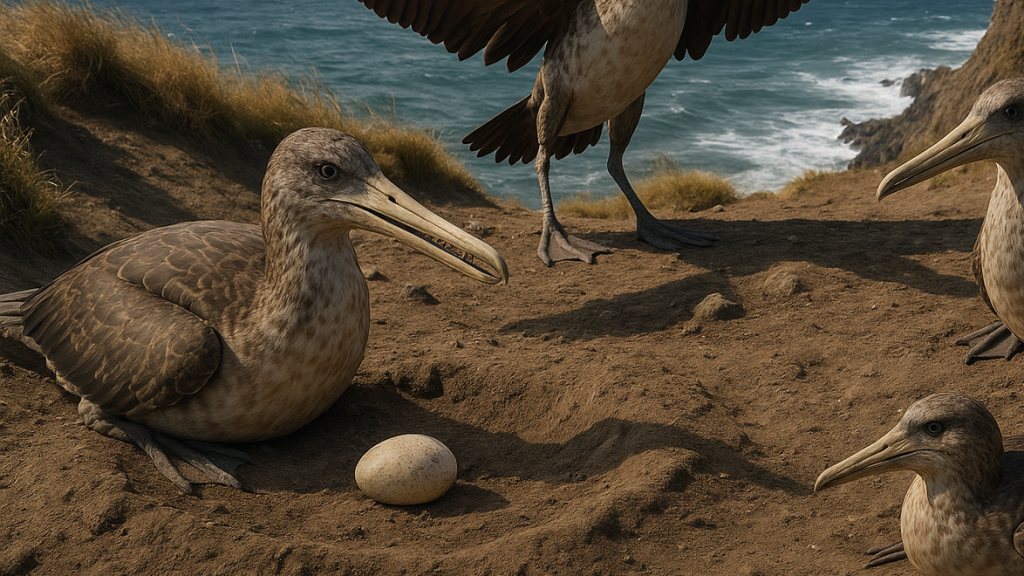
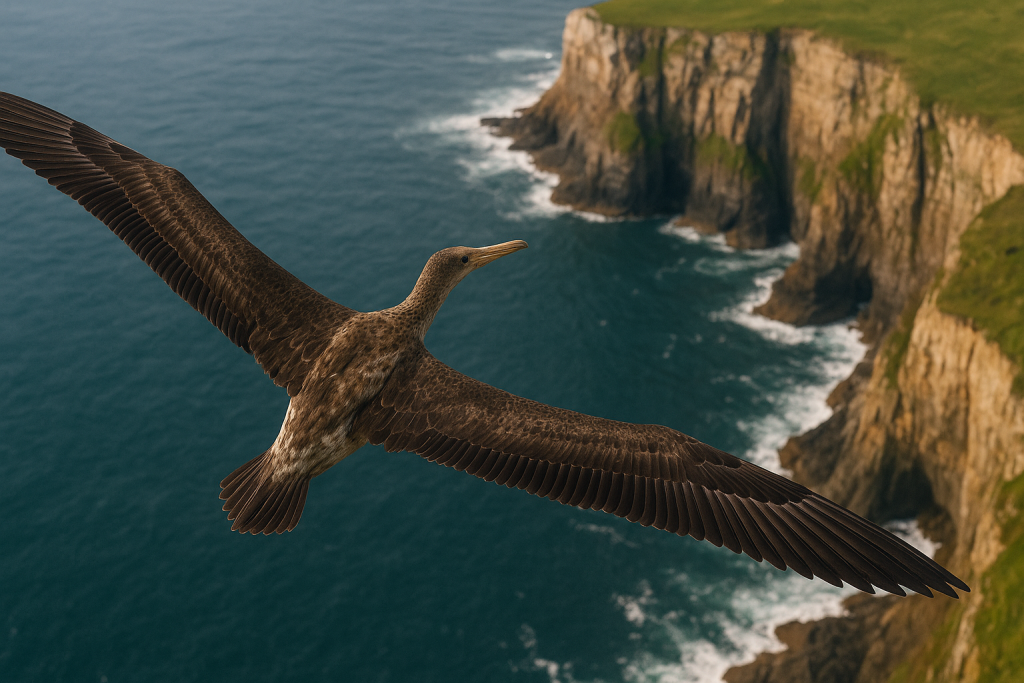
Where did Pelagornis sandersi nest? All evidence suggests it favored remote, predator-free coastal sites, much like modern seabirds. Pelagornis was a soaring oceanic bird, so nesting on land was a rare and critical part of its life cycle, likely undertaken only in particular safe havens. Given its enormous wingspan and limited agility in confined spaces, P. sandersi almost certainly required open, expansive nesting areas. Low-lying oceanic islands or coastal plateaus would have been ideal. The bird’s anatomy supports this: Pelagornis had relatively weak legs and likely could not take off from flat ground without wind, yet it had unusually wide, flattened toe bones that may have helped it brake and balance when landing on firm ground. This indicates it could land to nest, but needed favorable conditions. Researchers have argued that Pelagornis would not have been adept at perching on steep cliffs or in trees. Mark Witton (2018) notes that typical seabird cliff-nesting (as in gannets or murres) was probably impossible for such a long-winged bird, as a misjudged landing could leave a Pelagornis “splattered, Wile E. Coyote-style, on the side of a cliff”. Instead, P. sandersi likely nested atop cliffs or on broad ledges and flat ground above sea level. We can imagine colonies on windswept bluffs, coastal dune fields, or volcanic islands. These sites would provide strong updrafts for easy takeoff and isolation from terrestrial predators. In fact, fossil distributions of pelagornithids support this coastal nesting model. Their bones are often found in marine sediments near ancient shorelines. Notably, medullary bone (a special calcium-rich bone deposited by laying female birds) has been found in Pelagornis fossils from the Miocene of North Carolina. Medullary bone is only present when a female is breeding, implying those individuals died near a nesting area. This suggests that pelagornithids had breeding grounds not far from the coastal regions where they fed, rather than migrating deep inland. Paleogeographically, during the Eocene-Oligocene there were many low-lying islands, coral atolls, and high coastal terraces in warm climates that could serve as nesting sites. For example, the Early Eocene of Europe (London Clay deposits) shows pseudotooth birds lived in a shallow sea environment with land nearby. These birds likely nested on coastal high ground since far-off oceanic islands were less available in that region. Meanwhile, later Pelagornis remains along the Pacific and Atlantic coasts of the Americas hint that islands (now eroded or sunk) or coastal mountains were used.
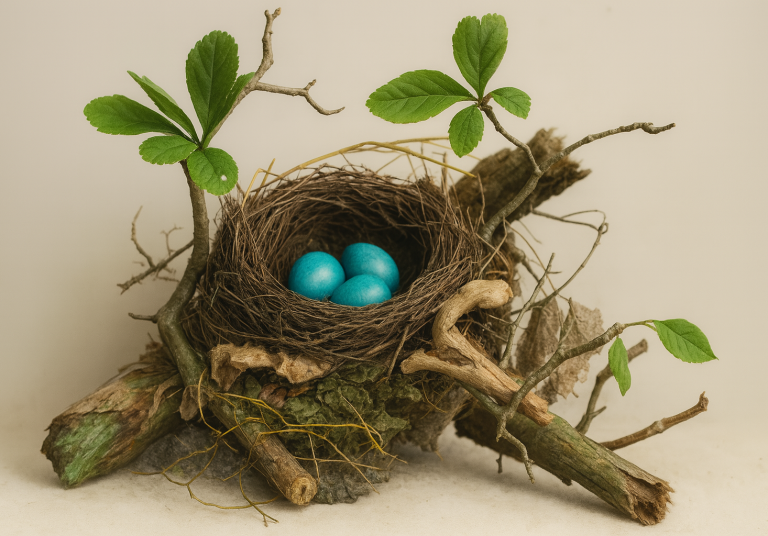
Pelagornis colonies may have been sparse compared to those of smaller seabirds, given the space each huge bird required. One can imagine a breeding colony akin to a group of albatrosses or pelicans: a loose aggregation of large nests, each a few meters apart, on a flat coastal grassland or sandspit. In the case of Pelagornis, even a colony of a few dozen pairs would be an impressive sight. There is no direct evidence of nesting material used, but by analogy, simple ground nests were likely constructed. Large seabirds today either make shallow scrapes or build up mounds of vegetation and soil. Albatrosses, for instance, scoop a hollow and pile grass, peat, or soil into a nest mound about 30–60 cm wide. Pelicans gather reeds and sticks on the ground. Pelagornis would have used whatever material was available such as dried seaweed, grasses, or even just a depression in sand or guano. The goal would be to stabilize the egg and insulate it from below. Given the warm climates of the Eocene, shade and ventilation were also important. Perhaps Pelagornis nested where sparse vegetation or rock outcrops offered relief from midday sun. In tropical settings, some seabirds nest under brush for shade. Pelagornis could have chosen spots with natural shade or relied on its own body to shade the egg.
Clutch Size and Incubation Strategy
All signs point to Pelagornis sandersi being highly K-selected. That is, raising very few offspring with high parental investment in an ecosystem conducive to such a breeding strategy. The clutch size was almost certainly one. Nearly all large seabirds today lay a single egg per breeding attempt. Albatrosses, frigatebirds, tropicbirds lay one egg. Extremely large extinct birds are inferred to do the same. The giant Argentavis is thought to have laid only one or two eggs every two years. Producing and incubating an egg is enormously costly for such big birds, and their slow reproductive rate is offset by a long lifespan and high juvenile survival. In rare cases a clutch of two eggs may have been possible, perhaps if resources were plentiful. A second egg might have been produced as insurance, similar to the way some eagles do but even if two hatched, typically only one chick would be raised in birds of this size.
Once the single egg was laid, Pelagornis sandersi parents would commence a lengthy incubation period. Large eggs generally have long incubation times, and cooler ambient temperatures or lower metabolic heat can extend it. In modern analogs albatross eggs are incubated ~70–80 days, and pelicans about 30–35 days. Considering its greater size, P. sandersi might have required in the order of 80–100 days of incubation before hatching. It is possible incubation even exceeded 3 months if the egg was especially large and conditions were cool. Both male and female Pelagornis would share this duty, as is the norm for seabirds. Biparental incubation is observed in albatrosses where partners take turns in shifts ranging from a day to multiple weeks and pelicans where male and female alternate daily or so. We can infer Pelagornis pairs alternated incubating the egg, allowing one to forage at sea while the other kept the egg warm. The shift lengths likely depended on foraging range and food supply. Given Pelagornis could soar over vast distances, one parent might range far for several days while the other fasted on the nest, similar to great albatrosses where one partner may take shifts up to 2–3 weeks in early incubation. Such long shifts would be energetically demanding for the fasting parent, but Pelagornis, like albatrosses, probably built up fat reserves and could lower its metabolism while sitting on the egg. The incubation strategy also had to account for environmental conditions. If P. sandersi nested in subtropical or tropical zones, likely for an oceanic bird during warm paleoclimates, overheating could be a concern. Modern pelicans cool their eggs in hot weather by soaking their feet in water and dripping it onto eggs, or by shading them carefully. Similarly, Pelagornis parents on hot days might have needed to open their wings slightly to shade the egg or stand up periodically to allow air circulation. In cooler periods or at night, they would snugly cover the egg with belly feathers assuming Pelagornis had an extensive abdominal brood patch as most birds do. Interestingly, in pelicans the parents actually incubate with their feet, essentially cradling the eggs in their webbed feet which have a rich blood supply. If Pelagornis was anatomically more like pelicans or waterfowl, as some studies suggest, it’s conceivable they used their feet to help incubate. However, given their immense size, it’s more likely they settled their entire body over the egg like an albatross, with the feet perhaps helping to gently position or protect the egg.
The climate of the Eocene–Oligocene might have influenced Pelagornis breeding timing. During the Eocene, global temperatures were very warm and seasonality was weaker near the poles . By the Oligocene, some cooling had occurred but conditions in P. sandersi’s known region of South Carolina were still temperate to subtropical. Climate-driven adaptations could include timing the breeding season to avoid extreme weather. For example, modern tropical seabirds often breed in the cooler dry season to avoid heat stress and summer storms. Pelagornis may have initiated nesting towards the end of a mild winter or in early spring, ensuring that incubation occurred in the cooler months and that hatching coincided with peak ocean productivity in spring/summer. The Argentavis study is illuminating here. Researchers hypothesized those giant vultures incubated during winter so that chicks hatched in a favorable season, with pairs swapping incubation every few days amid cooler temperatures. Pelagornis in a subtropical setting might likewise choose a season when wind conditions were reliable and aided flight, but not during hurricane season. In higher latitudes, if any pelagornithid nested near Antarctic coasts or such, they would certainly breed in the austral summer when 24-hour daylight would help foraging.
Another aspect of Pelagornis’s strategy was likely an extended breeding cycle. Great albatrosses famously breed only every two years because the chick requires almost a year of care and the parents then need to recover condition. It is plausible that P. sandersi also did not breed annually if the demands of raising a chick were too great. A pair might raise one offspring and then skip the next season to rebuild energy reserves. If food was abundant year-round, some pairs might attempt annual breeding, but the huge investment per chick makes this unlikely as a consistent pattern.
Parental Care and Offspring Development
Upon hatching, a Pelagornis sandersi chick would have been a relatively small, down-covered baby in contrast to its gargantuan parents. Because it hatched from a large egg, it would be fairly well-developed, but like most seabirds it was semi-altricial, meaning it required extensive care. The chick could not thermoregulate fully at first nor obtain food on its own, so continuous parental care was critical in the early weeks. Both parents likely participated actively in rearing the young. In modern albatrosses, the chick is brooded, i.e. kept warm and guarded, constantly for 2–3 weeks after hatching, with parents taking shifts. Pelagornis chicks would similarly require around-the-clock brooding initially, especially if nights were cool or if predators like gulls or small scavengers lurked.
For comparison, a wandering albatross chick fledges at ~9 months of age, despite being much smaller than an adult in mass. A Pelagornis chick, having to attain a huge wing size, might have taken well over 9 months, perhaps up to a year, to fledge. Indeed, the life-history model for Argentavis suggests the young were dependent for 16 months and didn’t reach full adult size until 10–12 years old. While Pelagornis might not have been quite that slow, it likely did not reach flight capability until many months after hatching. During this long nestling phase, the parents would feed the chick by regurgitation. Almost all seabirds feed their young by swallowing prey and then regurgitating a semi-digested slurry or whole pieces for the chick. Procellariiform birds (albatrosses, petrels) even produce an energy-rich stomach oil that they feed to chicks. A Pelagornis parent might have done something analogous, though its “teeth” (bony pseudoteeth) could have made the feeding a bit more challenging. The chick presumably did not have these pseudoteeth until near fledging, so the parent may have had to be gentle to avoid snagging the chick. Over the months of feeding, a Pelagornis chick would require a massive amount of food, likely many kilograms of fish per day as it approached full size. The parents probably foraged in alternating shifts once the chick was older with one parent returning with food while the other departed to feed. This relay could continue for many weeks. Like modern albatross chicks, the Pelagornis chick might have been left alone for longer periods once it grew large and thermally stable, with parents commuting from distant feeding grounds. During these later stages, the chick would sit tight and wait, possibly able to defend itself from smaller intruders with its beak. Predation at the nest was probably minimal. Thanks to the chosen nesting locale, isolated and often lacking large land predators, the main threats to a Pelagornis chick or egg would come from aerial or terrestrial opportunists like other birds.
Much like modern albatross colonies, the chief cause of egg loss might have been accidents e.g. egg breakage or exposure when a parent was startled into flying off, rather than predation. This sensitivity is noted in pelicans, which may crush eggs if suddenly alarmed. Pelagornis pairs likely had to be careful during takeoff and landing at the nest, coordinating their nesting changeovers to avoid jostling the precious egg.
As the chick neared fledging, parental care would gradually diminish. The youngster would exercise its wings, perhaps practicing flapping those 5+ meter wings on windy ridges. Eventually, it would take off when ready, possibly gliding down from a height to make its first flight. Similar to albatrosses, Pelagornis fledglings probably departed the colony alone and did not receive further feeding once they left. After fledging, the juvenile would roam the oceans and learn to fend for itself, not returning to land until it was time to breed years later. The estimated maturation time for Argentavis was over a decade. Pelagornis might have reached breeding age a bit faster, but likely still on the order of 5–10 years. Such a slow life history, with a low reproductive rate, could only succeed in an environment where adult survival was high. Indeed, with few natural predators and adept flight capabilities, adult Pelagornis sandersi probably had a high survival rate. This allowed the species to sustain itself despite each pair raising at most one chick every one or two years.
In summary, the nesting behavior of Pelagornis sandersi aligns with that of a long-lived seabird at the extreme end of the avian size spectrum. It would nest in remote coastal locales, lay a single large egg with a long incubation, and invest extensive parental care in a slow-growing chick. Many of these traits are mirrored in modern albatrosses and inferences made for other extinct giants like Argentavis.
Comparative Egg Characteristics of Pelagornis sandersi and Analogous Species
The following table summarizes the likely egg traits of Pelagornis sandersi in comparison to a large pelagic seabird (wandering albatross) and a large coastal waterbird (Dalmatian pelican). These analogs illustrate the range of egg sizes and reproductive strategies seen in large flying birds today, which inform our reconstruction of P. sandersi.
| Characteristic | Pelagornis sandersi Inferred (Oligocene giant seabird) | Wandering Albatross Diomedea exulans (largest modern seabird) | Dalmatian Pelican Pelecanus crispus (large coastal waterbird) |
| Adult body mass | ~25–30 kg (estimated) | 8–11 kg (female ~7.5 kg, male ~9.5 kg) | 10–12 kg (one of the heaviest flying birds today) |
| Egg dimensions | ~130–150 mm length, ~80–90 mm width (estimates) – very large oval egg, smaller than ostrich but larger than albatross. | ~120–130 mm length, ~75–80 mm width (large subelliptical egg). | ~100–106 mm length, ~60–64 mm width (oval egg). (Pelican eggs vary by species; Dalmatian among largest) |
| Egg weight | Roughly 500–1000 g (0.5–1.0 kg) – inferred. (Argentavis ~1 kg; likely mid-way between albatross and ostrich egg.) | 300–500 g (mean ~400 g for great albatrosses). | 120–195 g per egg. (Pelicans lay multiple smaller eggs.) |
| Egg shell & texture | Probably thick, matte off-white shell with slight granularity. Chalky calcium layer possible (like pelicans). Sturdy to support parent. | Dull white, relatively smooth shell with minor gloss; a few fine pores. Strong but thinner than ostrich. | Dull white chalky shell, coarse texture. Often coated with dirt/guano during incubation. Relatively brittle outer layer. |
| Egg coloration | Likely white or creamy with faint brown/red speckles on broad end (minimal camouflage). Stains over time. Adapted to open-nest with low predation. | White with reddish-brown spots (especially on larger end). Camouflage unimportant on predator-free islands. | Plain chalky white when laid; no markings. Becomes dirty yellow-brown by hatching. Colonies on isolated lakes need little egg camouflage. |
| Clutch size | 1 egg (very rarely 2?) – single offspring per breeding attempt. | 1 egg (always; albatrosses never lay more). | 2 eggs most common; range 1–3 (up to 6 reported). Usually only 1–2 chicks raised. |
| Incubation period | Estimated ~80–90+ days (2.5–3 months). Extended due to egg size and cool-season breeding. Both parents alternate shifts. | ~75–82 days (11–12 weeks) – one of the longest in birds. Biparental incubation (stints up to 2–3 weeks). | ~30–34 days (4–5 weeks). Both parents incubate in turns, usually daily changeover. Parents may use feet to cover eggs. |
| Nest type & location | Simple ground nest on remote coastal ground (island or cliff-top). Likely shallow scrape with vegetation or soil mound. Nest spaced out due to large size. High exposure to wind (needed for takeoff). | Mounded ground nest of mud, grass, or shrub on oceanic islands. Nest colonies on open slopes; needs approach space for landing. | Ground or floating platform nest of reeds/sticks on lakes or deltas. Often in dense colonies on islands or reed-beds. Some in low trees. |
| Parental care | Biparental: both male and female share incubation and chick-rearing. Long nesting period (chick may take 9–12+ months to fledge). One parent guards while other feeds, then swap. Very high investment per chick. | Biparental: lifelong monogamous pairs alternate incubation. After hatching, one parent guards for ~3 weeks, then both forage to feed chick. Chick fledges at ~9 months. Typically skip a year before next breeding. | Biparental: both incubate and feed young. Parents often switch daily during incubation. Chicks are semi-altricial; guarded constantly ~10–20 days, then form crèches (“pods”) while parents feed them for ~3 months. Breeding can be annual if food allows. |
Table 1: Comparison of egg and breeding characteristics of Pelagornis sandersi (inferred) with the wandering albatross and Dalmatian pelican. Pelagornis is reconstructed as having an egg significantly larger than any modern seabird’s, with a very low clutch size and prolonged development, reflecting an extreme K-selected life history. Data for modern species from cited references. (Note: Values for Pelagornis are estimates based on analogs and should be treated as informed speculation.)
Conclusion
Although no direct fossil egg of Pelagornis sandersi has been discovered, a synthesis of paleontological clues and comparisons to both modern and extinct birds allows us to paint a plausible picture of its reproductive biology. P. sandersi likely laid a single enormous egg that was subelliptical in shape, with a sturdy dull-white shell and minimal markings. The egg’s size of around 15 cm long and mass approaching 0.5–1 kg would have been commensurate with the bird’s huge body, yet constrained by the demands of flight. The nesting behavior of Pelagornis was finely tuned to its environment with adults nesting in remote coastal sites with ample space and wind, avoiding the need for agile flight maneuvers on takeoff or landing. These seabirds likely formed sparse colonies on island plateaus or isolated beaches, where ground nests could be safely situated away from terrestrial predators. The clutch of one egg and the prolonged incubation, in the order of 2–3 months, underscore a reproductive strategy focused on quality over quantity. Both parents would have invested heavily in incubating the egg during cooler periods and in rearing a slow-growing chick that may have taken close to a year to fledge. This strategy parallels those of the largest modern seabirds and the conjectured life history of other giant fliers like Argentavis.
The warm Eocene-Oligocene climate provided Pelagornis with widespread oceanic foraging grounds and likely some flexibility in timing breeding to favorable conditions. We infer that P. sandersi timed its nesting to avoid climatic extremes of intense heat or storms, much as modern tropical breeders do. Over geological time, these adaptations proved successful as pelagornithids thrived worldwide for tens of millions of years. Ultimately, understanding the egg and nesting of Pelagornis enriches our view of how the very largest birds solved the challenges of reproduction. In these giants, every stage, from selecting a windswept nursery, to laying a formidable egg, to carefully raising a single chick, reflects the exquisite balance required to be huge, airborne, and yet perpetuate the species. Future discoveries of fossilized eggshells or even a nesting site would be needed to confirm these inferences. Until then, we can draw on the threads of evidence from both ancient deposits and the habits of living seabirds, which together weave the remarkable story of Pelagornis sandersi’s family life on the primeval coasts.
References
- D.T. Ksepka, Flight performance of the largest volant bird, Proc. Natl. Acad. Sci. U.S.A. 111 (29) 10624-10629, https://doi.org/10.1073/pnas.1320297111 (2014).
- Palmqvist, Paul, and Sergio F. Vizcaíno. 2003. “Ecological and Reproductive Constraints of Body Size in the Gigantic Argentavis magnificens (Aves: Teratornithidae) from the Miocene of Argentina.” Ameghiniana 40 (3): 379–385.
- Witton, Mark P. 2018. “Those Terrific Pelagornithids.” Mark Witton’s Blog, 16 August 2018.
- Wikipedia. 2025. “Pelagornithidae.” Wikipedia, The Free Encyclopedia, last modified April 1, 2025.
- Wikipedia. 2025. “Argentavis.” Wikipedia, The Free Encyclopedia, last modified July 11, 2025.
- Wikipedia. 2025. “Dalmatian Pelican.” Wikipedia, The Free Encyclopedia, last modified August 4, 2025.
- Cornell Lab of Ornithology. n.d. “Brown Pelican Life History.” All About Birds. Accessed August 7, 2025.
- A-Z Animals Staff. 2024. “Pelagornis.” A-Z Animals (online wildlife encyclopedia), last updated May 27, 2024.