
The Philippine Eagle: Skull of a Forest Apex Predator
Introduction
The Philippine eagle (Pithecophaga jefferyi) is a breathtaking bird of prey found only in the rainforests of the Philippines. Revered as the country’s national bird, this giant raptor was once nicknamed the “monkey-eating eagle” for its presumed diet. It ranks among the largest eagles on Earth being the tallest and with one of the broadest wingspans (up to about 2 meters). Adults typically reach 90–100 cm in length and 4–8 kg in weight, sporting a shaggy crest of feathers on the head that gives them a fierce, maned appearance. In 1978 the species’ common name was formally changed from monkey-eating to “Philippine eagle” to foster national pride. Sadly, this magnificent raptor is critically endangered, with only a few hundred individuals remaining in the wild. Enthusiasts and scientists alike are fascinated by the Philippine eagle’s biology, especially its skull, which reveals many of the bird’s unique adaptations and its dominance as an apex predator.
A Forest King: Overview of the Philippine Eagle
Endemic to four islands in the Philippines (Luzon, Samar, Leyte, and Mindanao), the Philippine eagle inhabits dense tropical forests from lowlands up to about 1,500 m in elevation. In these lush canopies, it sits at the top of the food chain, earning it the local nickname “Haribon” (meaning “bird king”). With its broad, relatively short wings and long tail, the eagle maneuvers skillfully through foliage, a trait it shares with other rainforest eagles like Africa’s crowned eagle and South America’s harpy eagle. Its plumage is a striking mix of brown, white, and golden hues: a white belly and underwings, brown upperparts, and a fringe of long, lion-like feathers forming a crest on its head and nape. Uniquely, the Philippine eagle possesses bluish-gray eyes – an unusual eye color for raptors. Both males and females sport the dramatic crest, raising it when alarmed or during courtship displays. This species evolved to be extraordinarily large in part because it faced no natural predators in its ecosystem to compete with. Free from competition by big cats or other large carnivores, it became the rainforest’s top hunter, preying on a wide range of animals from flying lemurs and civets to birds and snakes. Despite the old “monkey-eating” moniker, monkeys form only a small part of its diet. Each of these traits, from its agile wings to its keen eyes, contributes to the eagle’s success. Yet, it is the skull and beak that truly set the Philippine eagle apart, showcasing evolutionary innovations that suit its predatory lifestyle.
Skull Anatomy of the Philippine Eagle
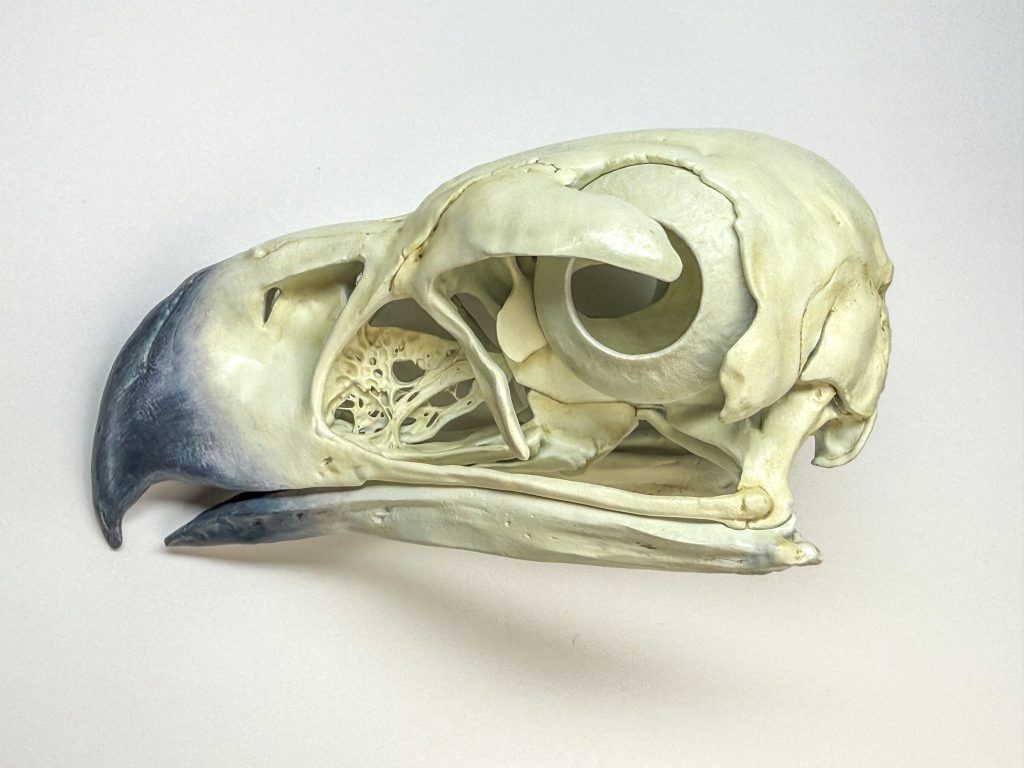
Figure: A Philippine eagle skull (side view). The massive hooked beak and large eye socket are evident, reflecting its role as a powerful predator.
The Philippine eagle’s skull is exceptionally large and robust, even compared to other giant eagles. Early naturalists noted that the skull of P. jefferyi is “enormous, very much larger than that of the Harpyr. The Philippine eagle’s skull measures about 14 cm in length, whereas a Harpy eagle’s skull is around 12 cm, underscoring the oversized dimensions of the former. This large skull accommodates several key features:
- Powerful, deep bill: The eagle’s beak is laterally narrow but incredibly deep (tall), giving it a stout, high-arched profile. In fact, the bill depth of the Philippine eagle is greater than that of any known bird of prey except the huge Steller’s sea eagle, and the combination of extreme depth and narrowness is unique among raptors. The upper mandible is strongly hooked with a razor-sharp tip, ideal for stabbing and tearing flesh. Its bluish-black coloration and imposing size make it a visually striking tool. This massive hooked bill attaches to the cranium with sturdy bony support, allowing the eagle to deliver killing bites and rip into the tough hides of prey.
- Large eye sockets (orbits): The skull’s orbits are huge, housing the eagle’s enormous eyes. Birds of prey like the Philippine eagle have eyes so large that they occupy a large portion of the skull. In eagles, the eyes can take up over 50% of the skull’s volume. In practical terms, each eye is almost as big as the eagle’s brain. These forward-facing orbits give the eagle binocular vision for judging distances when swooping on prey. The bony rim of the socket projects outward as a pronounced brow ridge. This brow ridge gives the eagle its famed “permanent fierce scowl,” but it also serves to protect the eyes from branches and sunlight glare. Behind each orbit, the skull provides ample surface area for attachment of powerful jaw muscles that clamp down with tremendous force when the eagle bites into prey.
- Robust yet lightweight structure: Like all birds, the Philippine eagle has a skull made of thin bone struts and fused plates. The structure is robust to withstand forces from struggling prey, but also lightweight (relative to its size) to allow flight. The braincase (cranium) is broad (about 7 cm wide), which not only houses the brain but also anchors strong neck muscles at the rear. These muscles, attaching around a ridge on the occiput of the skull, help the eagle carry heavy prey in its talons and tear off chunks of meat with its beak. The underside of the skull features a sharp, ridged palate and a roomy throat opening, adaptations that help the bird swallow sizable pieces of food. The beak and tongue do the work of teeth. The tongue even has backward-facing barbs to help swallow meat smoothly.
Adaptations for a Predatory Niche
Every aspect of the Philippine eagle’s skull ties into its role as an apex predator in the forest. First and foremost, the powerful beak and strong skull enable feeding on prey that few other raptors dare to tackle. This eagle often hunts animals such as civets, flying lemurs (colugos), large snakes, monitor lizards, and occasionally monkeys. Such prey can be heavy or potentially dangerous. The eagle’s deep bill delivers lethal punctures and can crack into body cavities to reach vital organs. The reinforced skull absorbs the shock when the eagle delivers high-impact stabs or tears at struggling prey. Observers have noted that a Philippine eagle can carry a monkey or a large flying lemur in its talons and dismember it with its beak back at the nest; a task requiring tremendous bite strength and skull stability. The tall, hooked beak is especially useful for pulling flesh from carcasses and breaking bones or skulls of prey, ensuring no part of a carcass goes to waste. In essence, the skull and beak function like a built-in butcher’s toolkit, perfectly suited for a carnivorous diet of sizable vertebrates.
The keen eyesight afforded by those large eyes and sockets is another crucial adaptation. In the dim interior of rainforests, spotting prey among shadows is challenging. The Philippine eagle’s eyes, among the most acute in the bird world, can see about five times more sharply than human eyes. Packed with densely clustered visual cells, its retinas and a unique structure called the pecten ensure it can detect even slight movements in the canopy. This eagle’s vision is often likened to natural binoculars. It can focus quickly and track moving prey through branches. For example, like other large eagles, a Philippine eagle could spot a small animal such as a squirrel from hundreds of feet away in the forest. The placement of the eyes gives a broad field of view with overlapping vision in front, which is invaluable for judging the distance to pouncing targets. The bony skull architecture (including that brow ridge) helps channel the bird’s vision forward, enhancing its hunter’s stare.
Living in forested mountains, the Philippine eagle has also adapted its hunting strategy to its environment. It often waits on a high perch, then swoops through the trees in a fast surprise attack. The skull and neck must endure the sudden impact of a strike, whether slamming into a flying lemur clinging to a trunk or grabbing a monkey mid-leap. The strong skull ensures that the eagle’s head (and precious eyes and brain) are well protected during these high-speed collisions with prey or vegetation. Additionally, when subduing prey, the eagle may suffer kicks or bites. A sturdy skull offers a degree of protection in these close struggles. The impressive crest of feathers on its head can be raised to make the eagle seem even larger and more formidable during territorial or predatory displays. This could intimidate rivals or even disorient prey for a split second in an attack.
Another fascinating behavior is cooperative hunting occasionally observed in Philippine eagles. Mated pairs have been seen working together, with one eagle distracting a group of monkeys while the other attacks from behind. Such complex behavior hints at a high intelligence and keen sensory awareness, traits supported by a well-developed brain. The eagle’s brain processes visual information rapidly and coordinates precision flight through cluttered forest. The Philippine eagle’s skull is the command center and chief weapon that have allowed this species to dominate its habitat. It exemplifies how anatomy aligns with ecology.
Conservation Status and Significance
Despite its majesty and power, the Philippine eagle is teetering on the brink of extinction. It is classified as Critically Endangered, making it one of the world’s most threatened raptors. Scientists estimate that only a few hundred Philippine eagles remain in the wild; possibly as low as 250 to 500 individuals. The primary threat to their survival is habitat loss. The old-growth forests that these eagles require for hunting and nesting have been ravaged by deforestation, logging, and land conversion across the Philippines. As the forests disappear, the eagles lose the space and prey base they need. Additionally, some eagles fall victim to shooting or trapping, despite laws that strictly prohibit killing a Philippine eagle (offenders face up to 12 years in prison and heavy fines). Tragically, even the most robust skull and talons cannot defend the species against rifles or chainsaws.
Conservation efforts are underway to save this iconic bird. The Philippine Eagle Foundation and other groups engage in captive-breeding programs and have successfully bred and released a number of eagles back into the wild. They also work with local communities to promote forest protection and reduce hunting, emphasizing the eagle’s cultural importance and its role in the ecosystem. In Philippine folklore and national symbolism, this eagle is a source of pride and wildlife richness. Ecologically, it’s an “umbrella species,” meaning that protecting the Philippine eagle and its large territory indirectly protects countless other species sharing the same habitat. Each nesting pair needs a vast home range of forest, so conserving them helps preserve large tracts of biodiversity-rich land.
The skull replica described below serves as more than a display piece. It is a reminder of the marvel of evolution and the fragility of an irreplaceable species. Examining a replica or museum specimen of a Philippine eagle’s skull can inspire awe at its adaptations, but also reflection on what could be lost if these birds vanish. The hope is that through education and conservation action, the Philippine eagle will continue to reign with its impressive skull and keen eyes over the Philippine forests for generations to come, rather than becoming a mere relic of natural history.
Crafting a Skull Replica
Creating a replica of the Philippine eagle’s skull requires accuracy, artistry, and a deep understanding of the bird’s anatomy. The process begins with research; studying photographs, measurements, and descriptions of actual skull specimens. Knowing the precise dimensions is crucial for creating an accurate 3D model. The goal is to capture every ridge and curve: the broad cranium, the towering beak, the orbital rims, and even the delicate openings for nerves and blood vessels. The replica is composed of separate pieces for the cranium and mandible.
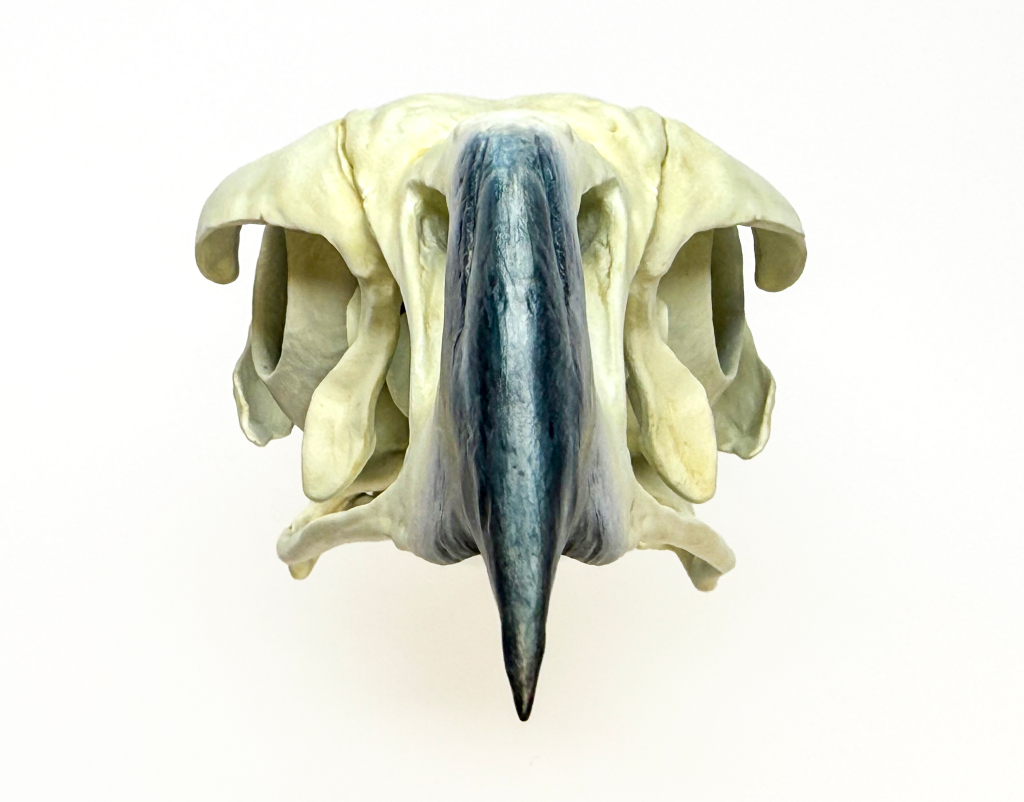
One of the challenges in replicating a bird skull, especially of a large raptor, is conveying its lightweight yet strong construction. The walls of bird skull bones are thin and sometimes slightly translucent. In a replica, achieving this involves careful thinning of 3D printed parts using a light resin. Detailing is key; the texture of the bone surface, the pattern of sutures (fusion lines), and the curved beak tip all add to realism. The finished skull replica is painted and stained to resemble aged bone, and to be hyperrealistic.
The replica has significant educational value. It allows bird enthusiasts, students, and museum-goers to handle and examine the anatomy of this rare eagle without harming any living creature. By observing the replica, one can appreciate features like the enormous eye sockets and the expanded nasal openings at the base of the beak, which likely aid its sense of smell and respiration during vigorous activity. Educators can use the skull model to point out how the hooked beak works like a knife and fork for the eagle, or how the strong jaw hinge and skull shape allow it to exert great bite force. For many, seeing a life-sized skull up close personalizes the concept of an endangered species.It’s no longer an abstract idea, but a tangible creature that evolved over eons and now needs our help to survive.
In summary, crafting a Philippine eagle skull replica blends science and art. It celebrates the eagle’s unique adaptations while also spreading awareness. Each ridge and contour in the replica tells a part of the story of how the Philippine eagle became the ruler of its realm. And when displayed, whether on a collector’s shelf or in a nature center, the replica stands as a powerful conversation piece about conservation, evolution, and the marvelous creatures we share our planet with.
Sources: The information in this article is drawn from authoritative sources on the Philippine eagle’s biology and conservation. These sources have been cited throughout the text to provide further reading and verification of facts:
- Oriental Bird Club’s bulletin: orientalbirdclub.orgorientalbirdclub.org, First described the eagle’s remarkable skull and bill.
- Skullsite: skullsite.com. Providing skull measurements and photographic references.
- Animal Diversity Web and Peregrine Fund: peregrinefund.org. Providing species profiles and documented observations of the eagle’s behavior and traits from field researchers.